
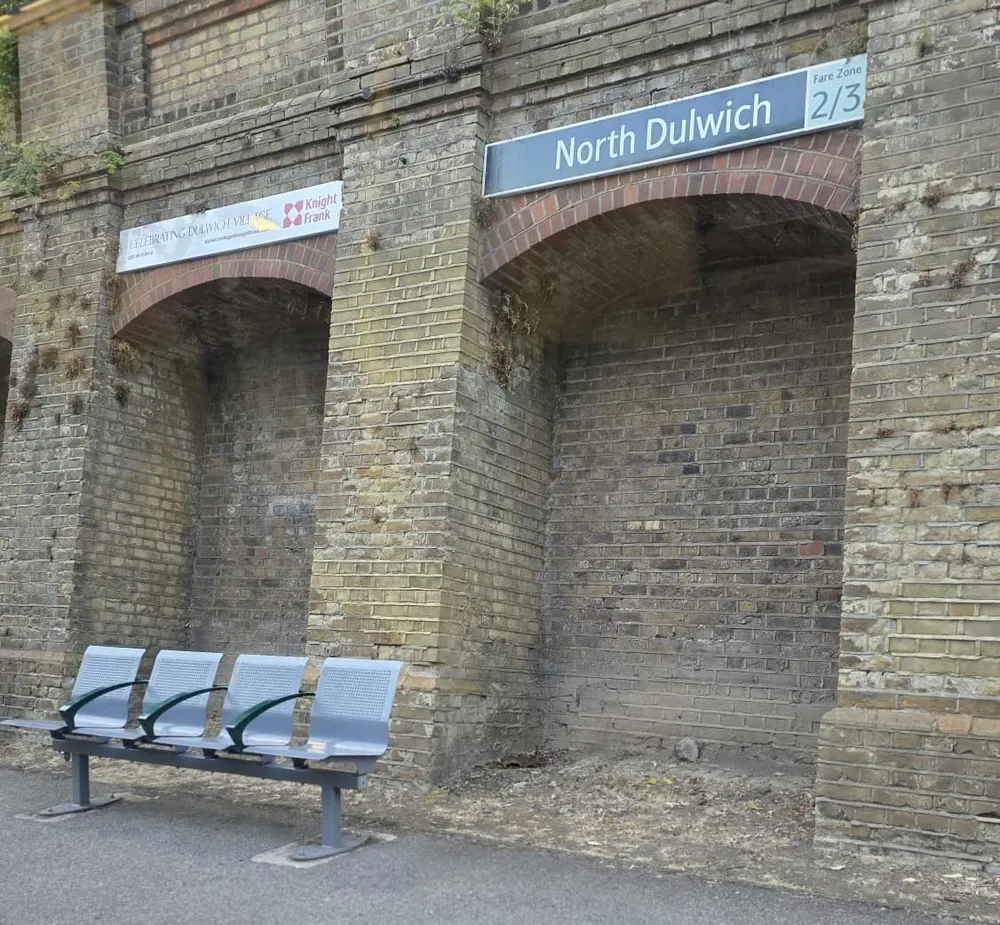
Standing on the platform at North Dulwich Station, one is confronted by a scene so familiar that it is easily overlooked. Trains arrive and depart. Commuters glance at departure boards and disappear into the rhythm of the city. The great Victorian retaining walls and brick piers that define the station have become part of the unnoticed landscape of everyday life. Yet a closer inspection reveals something rather different. Across the brickwork are the unmistakable signs of distress: spalled brick faces, failed repairs, widening joints, salt staining, vegetation growth and areas of crude patching that interrupt the coherence of the original masonry. What appears at first glance to be the inevitable consequence of age is, in reality, evidence of a far more recent problem—the widespread replacement of traditional lime mortars with hard cement-based alternatives.
The walls at North Dulwich tell a story that is repeated across Britain. It is a story not simply about brick and mortar, but about the gradual loss of traditional knowledge and the tendency of modern society to substitute industrial solutions for systems it no longer fully understands. In this respect the damaged brickwork serves as a useful metaphor for a wider condition. The deterioration visible today is not primarily the result of Victorian builders getting things wrong. Rather, it is the consequence of later generations assuming that newer materials must necessarily be superior to older ones.
For centuries, brickwork in Britain was constructed using lime mortars that were intentionally softer, more porous and more flexible than the bricks themselves. These mortars formed part of a sophisticated environmental system that regulated moisture movement throughout the wall. Water could enter the masonry, but it could also leave. Movement within the structure could be accommodated without significant damage. Most importantly, the mortar acted sacrificially. It weathered and eroded so that the bricks did not.
This principle has been explored extensively by Dr Gerard Lynch, one of Britain's foremost authorities on historic brickwork, a master brickmason, consultant and author whose work has helped shape modern understanding of traditional masonry conservation. Writing on historic joint finishes and traditional brick construction, Lynch argues that lime mortars were never primitive precursors to cement but highly developed materials specifically suited to traditional brickwork. Their softness and permeability were not weaknesses but essential characteristics that enabled historic walls to function successfully over centuries.
The brickwork at North Dulwich was built upon precisely these principles. The yellow London stock bricks visible throughout the station were intended to work in partnership with lime mortar. Together they formed a breathable construction system capable of managing moisture, movement and weathering in a remarkably effective manner. Victorian railway engineers understood this, even if they did not employ the language of modern building physics. They knew through experience what materials worked together and which did not.
The arrival of Portland cement altered that relationship. As industrial construction expanded during the nineteenth and twentieth centuries, cement became increasingly associated with strength, permanence and progress. Its extraordinary success in engineering projects encouraged the assumption that it represented a universal improvement upon older materials. If lime mortar weathered, then a harder material must surely be better. If lime required periodic maintenance, then permanence appeared preferable. Such assumptions were understandable, but they ignored a fundamental truth: traditional buildings had not been designed to accommodate cement.
The consequences can be read directly from the walls at North Dulwich. Across the station, hard cementitious repairs remain largely intact while the surrounding historic bricks have deteriorated. This apparent contradiction is one of the defining symptoms of inappropriate conservation practice. The material introduced to strengthen the wall survives, while the original fabric is sacrificed. Moisture that once evaporated harmlessly through porous lime joints becomes trapped within the masonry. During periods of frost, water expands within the brick itself, forcing away the fired outer surface. Brick faces detach. Arrises break down. Surface erosion accelerates. The wall begins, quite literally, to consume itself.
The conservation practitioner Terrence Lee, whose work focuses on traditional brickwork and maintenance, has described this process in particularly stark terms. Hard cement pointing traps moisture within historic walls, preventing normal evaporation and creating conditions in which bricks become saturated. When freezing occurs, damage concentrates within the masonry rather than the joints. The result is the gradual destruction of the very material the mortar was intended to protect.
The photographs from North Dulwich illustrate this process with remarkable clarity. Large areas of the original fire skin of the bricks have disappeared, exposing softer internal material. White deposits indicate the movement of moisture and soluble salts through the masonry. Vegetation has established itself within joints and cracks, suggesting long-term moisture retention. Numerous repairs interrupt the historic fabric, some using bricks that fail to match the original masonry either aesthetically or technically. These interventions may have been undertaken with the best intentions, yet collectively they reveal how easily historic character can be diminished through misunderstanding rather than neglect.
The issue extends beyond mortar alone. As Dr Moses Jenkins of Historic Environment Scotland has argued, successful brick conservation depends not merely upon replacing damaged units but upon understanding the complex technical characteristics of historic masonry. Replacement bricks must be matched not only in colour and appearance but also in their texture, water absorption rates, durability and overall behaviour within the wall. A poor repair can create new vulnerabilities, introducing materials that perform differently from those surrounding them and accelerating future decay.
Viewed in this context, North Dulwich Station becomes more than a case study in brick decay. It becomes an illustration of what happens when traditional systems of knowledge are displaced by assumptions about modernity. For generations, bricklayers understood that mortar should be weaker than brick. Maintenance was expected. Repairs were anticipated. Buildings were conceived not as static objects but as living structures that required periodic care. The twentieth century often approached the same problem from an entirely different perspective, seeking permanence where earlier builders had accepted cycles of renewal.
Perhaps the greatest irony is that the Victorian craftsmen responsible for these walls would not have been troubled by the gradual erosion of lime mortar. They expected it. What they could never have anticipated was the widespread belief that maintenance could be eliminated altogether through harder materials. The damage visible at North Dulwich today is therefore not a failure of Victorian brickwork. It is evidence of a later failure to understand how that brickwork was intended to function.
Heritage is not always lost through demolition. Sometimes it disappears more quietly. A repointing campaign here. A patch repair there. A specification that substitutes convenience for compatibility. Decade after decade, the cumulative effect becomes visible in walls such as these. The structure remains standing, but the knowledge embedded within its materials is gradually erased.
Conservation is ultimately an act of understanding before it is an act of repair. The first task is not to intervene, but to learn what the building is trying to tell us. Only then can we begin to reverse the slow violence inflicted when cement meets history.
For those responsible for maintaining historic brick structures, finding appropriately qualified contractors is an essential part of that process. Readers seeking specialist brickwork conservation expertise, including lime repointing, brick matching and traditional masonry repairs, can explore the ConserveConnect Brickwork Directory at https://conserveconnect.com/services/brickwork.
Further Reading
- Dr Gerard Lynch – Master Brickmason and Historic Brickwork Consultant: https://www.brickmaster.co.uk
- Terrence Lee Conservation: https://terrenceleeconservation.co.uk
- Historic Environment Scotland – Technical Conservation: https://www.historicenvironment.scot