

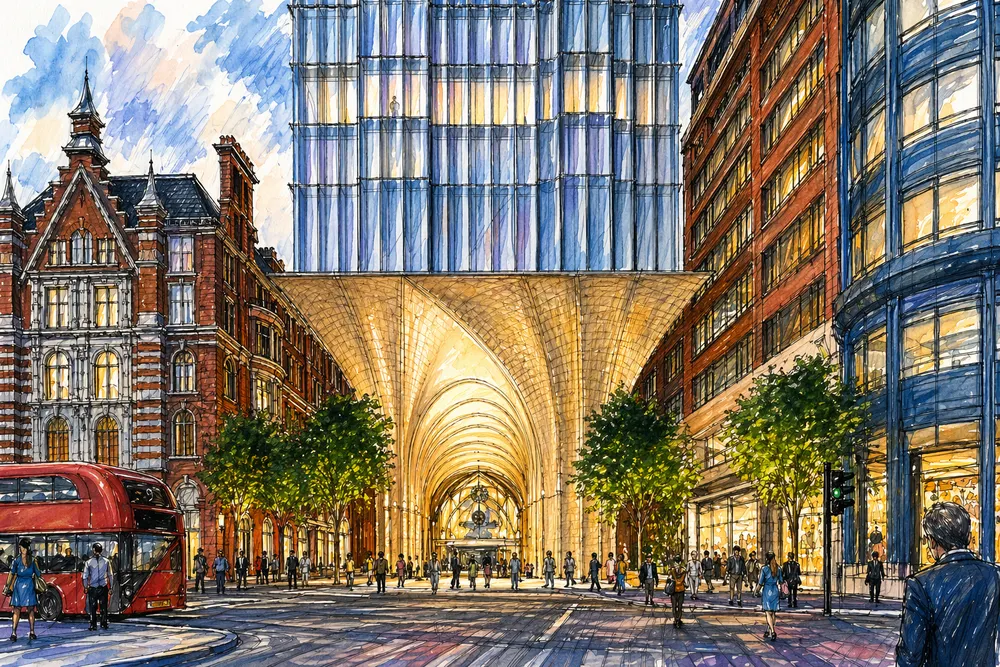
Liverpool Street Station needs renewal. But London should not accept, by default, a model in which essential public transport improvement is bundled to a vast over-station commercial scheme without a clear, publicly intelligible station first baseline. The City of London approved the redevelopment on 10 February 2026. The Mayor of London now has the power at Stage 2 either to let that decision stand, to direct refusal, or to take over the application himself. We are asking him to intervene.
Sign the Open Letter to the Mayor of London
Liverpool Street Station is one of London’s great transport gateways. It is infrastructure of national importance, a major heritage site, and a hinge between the City and the wider life of the capital. It needs investment. It needs improved accessibility. It needs a better passenger environment. But need is not the same thing as a blank cheque.
The approved application is not simply a station upgrade. It includes a 19 storey over-station office development reaching 97.64 metres, with 88,013 square metres of office floorspace gained. The planning material also makes clear that the over-station office development and enhanced retail provision are part of the self-funding logic used to finance the station improvement works.
That is why this now requires Mayoral intervention. The question is not whether Liverpool Street should be renewed. The question is whether the public has been asked to accept a bundled commercial model as though it were the only way to secure improvements to a station that plainly requires attention.
The Mayor’s strategic planning powers exist for precisely such moments. We are asking him to use them.
Add your name below to support this open letter.
Open Letter to the Mayor of London
To the Mayor of London, Sadiq Khan,
Liverpool Street Station is one of London’s principal gateways. It is transport infrastructure of national importance, a major heritage site, and a place where the civic, architectural and economic life of London meet. The City of London approved the current redevelopment scheme on 10 February 2026. The Mayor now has the statutory power, at Stage 2, to allow that decision to stand, to direct refusal, or to take over the application himself as local planning authority. The GLA’s own guidance states that this decision must be taken within 14 days of the Stage 2 referral. (london.gov.uk)
We are therefore calling on you to intervene.
We do not do so because we oppose investment in rail infrastructure, improved accessibility, or the renewal of a station that plainly requires improvement. The application material itself places great weight on the need for increased capacity, better circulation, enhanced accessibility and a more coherent passenger environment. That is not the issue. The issue is whether those necessary public aims have been used to carry a scale and form of over-station commercial development that was never subjected to a sufficiently transparent, strategically intelligible, station first test.
What has been approved is not simply a station upgrade. It is a package of very substantial demolition, reconstruction, retail intensification and office development above the station. The application form records an over-station building reaching 97.64m with 19 storeys, and a gain of 88,013 square metres of office floorspace.
That distinction matters. Public necessity should discipline a scheme of this kind. Instead, public necessity appears to have been used to normalise a commercial quantum whose heritage, townscape and civic consequences were treated as the acceptable price of improvement rather than as matters requiring a more exacting strategic test.
The planning statement itself says that the proposed over-station office development, together with enhanced retail accommodation, will help finance the station improvement works and that the applications were submitted on the basis that the scheme would be entirely self-funded. In other words, the public case and the commercial case were bundled together from the outset.
This is precisely why intervention is now needed. The question is not whether Liverpool Street should be renewed. It is whether London should accept, as a matter of planning principle, that major public transport upgrades in highly sensitive locations must be secured only by loading substantial commercial office mass onto them, and then presenting that bundle as if there were no real alternative.
A genuine station first approach would have required a legible baseline: a clear account of what works were essential to the station, what they would cost, what harm they would entail, what could be achieved with lower harm alternatives, and only then what, if any, additional development could be justified. Without such a baseline, public benefit ceases to be a test of necessity and becomes instead a way of insulating a preferred commercial model from proper scrutiny.
The GLA’s own guidance explains that, under article 7 of the 2008 Order, the Mayor may take over an application where the development would have a significant impact on implementation of the London Plan, would have significant effects likely to affect more than one London borough, and where there are sound planning reasons for intervention. The same guidance explains that, under article 6, the Mayor may direct refusal. (london.gov.uk)
This case plainly raises strategic London issues. Liverpool Street is one of the capital’s most important transport nodes. The City itself described the approval as a major redevelopment of Britain’s busiest station. (news.cityoflondon.gov.uk) The implications are therefore not merely local. They concern how London governs growth, how it treats heritage in transport-led development, and whether infrastructure renewal is to become a standing justification for commercial intensification on terms the public is never properly invited to test.
We therefore ask you to act.
Intervention here would not be an act against renewal. It would be an act in favour of transparent, disciplined and strategically accountable renewal. It would say that London accepts the need for better stations, better access and better public realm, but does not accept that these must be tied by default to the largest commercially convenient form of over-station development in every case.
Liverpool Street deserves renewal. Londoners deserve clarity. And this case now requires the exercise of your powers in the public interest.
Yours sincerely,
The undersigned
Why This Matters
This is not only a heritage question, though heritage is plainly at stake. Nor is it only a design question, though design and townscape are central. It is also a question of political economy.
When a major public transport upgrade is said to depend on a very large commercial office scheme, the planning balance is altered from the beginning. The public is told that the station must improve. That is true. But if the only model placed before the public is one in which those improvements are fused to a large commercial structure above, then necessity begins to do work it should not do. It stops being an argument for renewal and becomes an argument for whatever scale of development has been attached to that renewal.
That is the deeper concern here. London must not drift into a planning culture in which public infrastructure becomes the platform upon which private development quantum is naturalised, and where the resulting harms are treated as unfortunate but unavoidable. That is why Liverpool Street matters. And that is why this decision now matters beyond Liverpool Street itself.
Add Your Name
If you believe the Mayor of London should intervene in the Liverpool Street Station redevelopment, add your name.
We are asking for a more rigorous, more transparent, and more genuinely public test of what Liverpool Street needs, what level of harm is truly necessary, and what has simply been folded into the scheme because no adequate station first alternative was ever clearly presented.
Support a Station First Alternative
You may also wish to write directly to the Mayor of London using the official City Hall contact form: https://www.london.gov.uk/contact-us-form. A personal message can help show the depth of public concern and underline that Liverpool Street Station should be renewed through a clear station first approach, not through a bundled scheme in which essential public infrastructure is used to justify excessive over-station commercial development.