
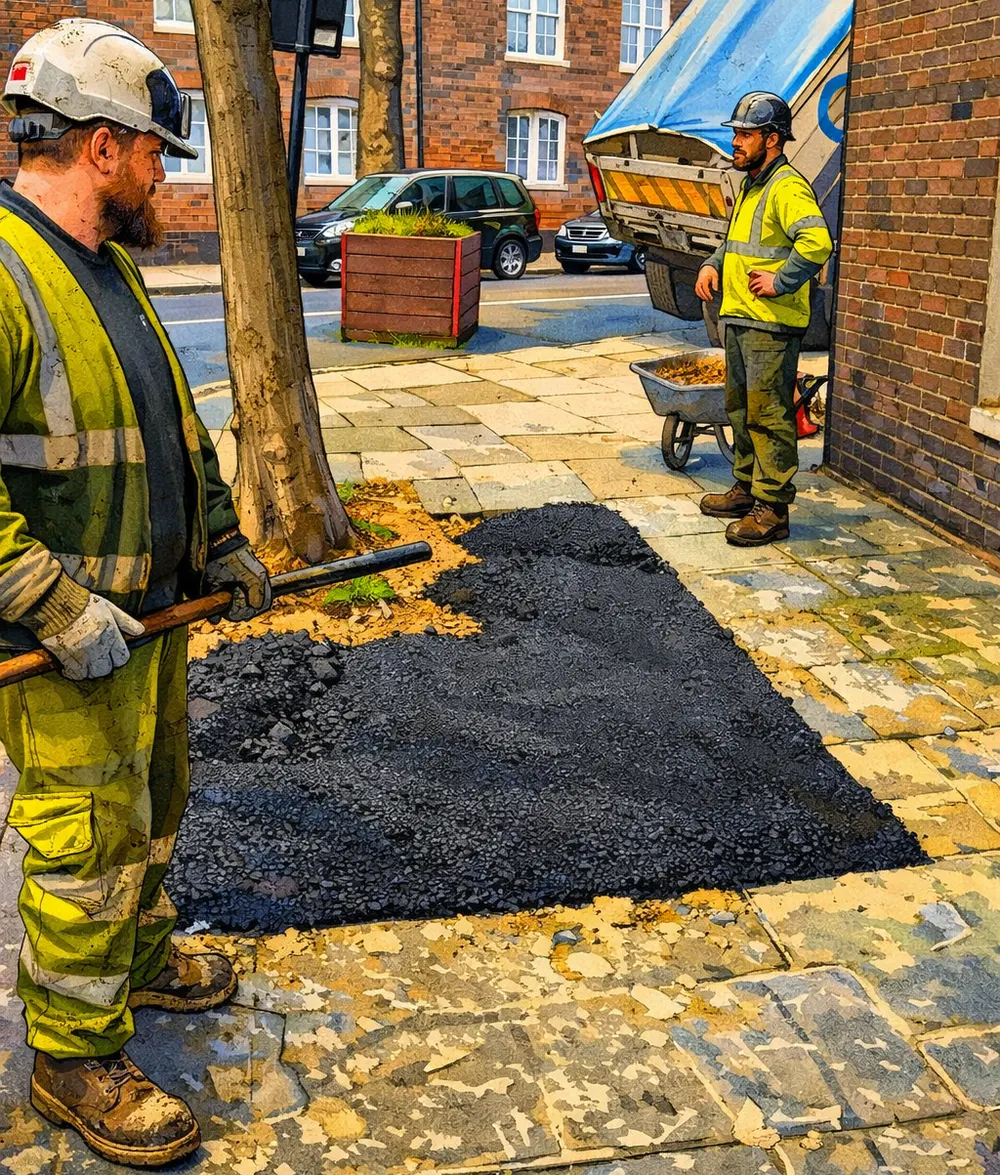
In Tower Hamlets, in a conservation setting where the very point of designation is that special attention should be paid to preserving or enhancing character, historic York stone paving has been removed and covered with asphalt. ConserveConnect’s reporting on the incident framed it plainly, and correctly, as the removal of historic paving in a conservation area and its replacement with asphalt “as a matter of convenience.” Tower Hamlets’ own conservation documents, meanwhile, repeatedly state that conservation areas are subject to a statutory duty of preservation or enhancement, and in several areas of the borough they explicitly recognise York stone paving, setts, and traditional surface treatments as part of local character. In the York Square Conservation Area appraisal and management guidelines, for example, the borough notes that some York stone paving survives, has been recently reinstated in some areas, and that future similar works are encouraged. In the Swaton Road Conservation Area guidance, remnants of York stone paving are described as contributing to Victorian character.
One must begin there, with the ground itself, because it is one of the small vanities of advanced administrative societies to imagine that their greatest transformations take place only in the grand arena, in parliament, in the balance sheet, in the announced reform. Often they do not. Often they arrive beneath the feet of ordinary people, in the altered pavement, the patched square, the downgraded surface, in those modest adjustments that appear too trivial to deserve public grief and too technical to deserve political anger. The stone goes, the asphalt arrives, the pedestrian continues on, and life seems to proceed without rupture. Yet what has changed is not merely the material. What has changed is the standard by which the common world is held.
York stone is not only stone. It is a way of making public space legible as something meant to last, something not wholly subordinate to the immediate demands of cheapness, speed, and administrative convenience. Asphalt is not only asphalt. It is the material answer of a system under pressure, a surface of expediency, a declaration, all the more powerful because it is unspoken, that continuity can now be compromised where once it would have been defended. The substitution is not simply technical. It is moral, political, and historical. It reveals a changed relation between government and the public realm.
If one were to treat the Tower Hamlets paving as an isolated irritation, one would miss its meaning. The task is to see in the local surface the outline of a larger order. That order becomes clearer the moment one steps back from the pavement and looks at the condition of heritage and local public life more broadly. Historic England’s 2025 Heritage at Risk findings record thousands of sites across England threatened by neglect, decay, or inappropriate development. At the same time, Historic England’s own research on local authority historic environment services shows the further thinning of specialist conservation and archaeology capacity. The institutional ecology required to notice, understand, and resist loss is itself becoming thinner.
The same pattern is visible in local cultural provision. The House of Commons Library briefing on the contribution of local museums reported in March 2026 that 139 local authority museums have closed since 2000, and that finance was the most common reason. Its briefing also records a steep long term fall in local authority museum expenditure. This matters because museums, like paving, squares, parks, libraries, and civic halls, belong to the same family of things. They are among those parts of the public world whose worth is plain in lived experience but perpetually vulnerable in systems that demand immediate financial justification.
What appears in Tower Hamlets, then, is not a freakish mistake. It is one expression of a national condition. The danger lies precisely in the fact that the act is so small. It can be rationalised, shrugged off, folded into the endless catalogue of routine works. But that is how decline succeeds in modern societies, not chiefly by spectacular destruction, but by making each act of diminishment appear too minor to contest on its own. A paving material is altered, a frontage simplified, a building sold, a museum closed after prolonged weakening, a conservation area managed to a lower material standard. Each act is local, but the logic is systemic.
The first explanation usually offered for such outcomes is austerity, and it would be foolish to deny its force. Tony Travers has repeatedly argued that local government spending on neighbourhood and environmental services has been severely reduced since 2010, even as pressures elsewhere, above all in social care, have grown. In plain terms, the local state has been starved while demands in other areas have continued to rise. That pressure is real. It helps explain why the public realm, being largely non statutory, is repeatedly sacrificed in order to preserve those services which councils are legally bound to provide.
Yet austerity, though necessary to the explanation, is not sufficient. It tells us why councils are under pressure. It does not fully explain why the response so often takes the form of cheap substitution, asset disposal, transfer, outsourcing, viability, and the now routine language of optimisation. To understand that, one must move from fiscal stress to political economy, from scarcity to the social order that scarcity serves.
This is where the literature on rentier capitalism becomes indispensable. Brett Christophers, in work that now stands near the centre of any serious account of contemporary Britain, has shown that the economy has become increasingly organised around income derived from the ownership and control of assets, land, property, infrastructure, rights, rather than from production in any older industrial sense. In The New Enclosure, he traced the vast transfer of public land into private hands. In Rentier Capitalism, he demonstrated the extent to which extraction from existing assets has come to dominate economic life. One need not force the argument to see the implication. Under a rentier order, public things do not need to be abolished to be transformed. They need only be made newly legible as assets, liabilities, opportunities, or service burdens.
The public realm suffers precisely at this point of reclassification. A pavement ceases to be part of a civic inheritance and becomes a maintenance cost. A museum ceases to be a public good and becomes an expenditure problem. A historic building ceases to be an obligation of stewardship and becomes a liability, unless some commercial or redevelopment logic can be attached to it. A street, in the bloodless vocabulary of managerial local government, becomes part of a public realm services model. It is hard to imagine a phrase more revealing. The very syntax discloses the transformation. The street is no longer first a shared world, but a service bundle, something to be procured, delivered, rationalised. Once that vocabulary settles, certain material outcomes become far easier to justify.
Tower Hamlets is especially telling because the borough’s own conservation material makes clear what ought to be at stake. Conservation areas are designated under a statutory framework that requires special attention to the desirability of preserving or enhancing their character or appearance. In several Tower Hamlets conservation documents, traditional stone paving, York stone, blue brick, granite kerbs, and historic street surfaces are identified as elements contributing to local significance. In one area, the documents explicitly note that “some York stone paving survives and has been recently reinstated in some areas.” In another, they refer to original setts and York stone as part of the streetscape character. The borough therefore knows, in documentary form, what such surfaces mean. Their significance is not hidden. It is written into the planning and conservation apparatus itself.
And that is precisely why the removal matters. It is not only that a good material has been replaced by a worse one. It is that the system contains within itself the language of preservation while increasingly tolerating outcomes of diminishment. Here one reaches the problem of the compromised guardian. Historic England remains an important institution, and local conservation officers continue to work under difficult conditions, but they operate within a planning order whose dominant categories are no longer those of uncompromising stewardship. They are significance, harm, mitigation, public benefit, enabling development, viability. These are not meaningless concepts. They can be instruments of defence. But they are also instruments of accommodation. Harm is often not prohibited, but balanced. Loss is processed, measured, justified, and, where necessary, accepted. The guardian remains, but the role is altered. It no longer simply refuses. It mediates.
The same mutation is visible in planning more broadly. Chris Foye’s work on Section 106, viability, and the depoliticisation of English land value capture is especially valuable because it identifies how land value capture and planning judgement have been depoliticised. The rise of home ownership and broader rentierisation, he argues, strengthened support for house price inflation and private property rights, shrinking the space for democratic challenge. Meanwhile the Section 106 and viability regime fragmented decision making through consultants, expert models, and technical rules that reduced the discretion of elected local planning authorities. What had once been political contest became, increasingly, a matter of what the models would allow. Policy moved away from contingency and contestation, toward fate and necessity. It is difficult to think of a more exact description of the atmosphere in which the public realm is now administered.
For once the language of viability enters with full authority, public judgement is progressively displaced. The question ceases to be what ought to be demanded in order to preserve the dignity of place. It becomes what can be shown to be affordable within a private financial model. Like for like reinstatement may be desirable, but is it viable. Higher quality materials may be more appropriate, but can they be justified. Better public realm may be plainly in the public interest, but will it threaten delivery. In this way the democratic question is steadily translated into technocratic form. One is told, in effect, that the common world may be defended only to the extent that it does not obstruct the imperatives of value extraction.
This helps explain why the local authority itself appears increasingly contradictory. Councils are starved by central government, yet expected to behave entrepreneurially. They are urged to unlock value from land, enter development partnerships, establish companies, and seek revenue from property. Joe Penny’s work on speculative urban statecraft and local state rentierism is exact because it captures this historical twist. The local state is not simply the victim of rentierism. It is drawn into its practices. It becomes, however reluctantly, a participant in the management of assets for return. At that point the old role of steward is not abolished, but subordinated. The council is recast as broker, facilitator, manager, junior partner.
It is here that the argument must widen beyond heritage narrowly conceived. For the treatment of York stone in Tower Hamlets belongs to the same national grammar that has shaped the privatisation of water, the reorganisation of rail, the transfer of public land, the outsourcing of services, and the more general conversion of public infrastructures into sites of extraction. These are not identical phenomena, but they are analogous. In each case, what was once held at least partly outside the pure logic of return is increasingly drawn into it. The public good survives only conditionally, only where it can be reconciled with revenue, optimisation, or constrained expenditure. What cannot justify itself in such terms is progressively weakened.
This is why the literature on urban political economy matters so much here. It clarifies that what we are seeing is not a loose collection of poor decisions but a patterned order of diminishment. Paul Watt’s Estate Regeneration and its Discontents shows how neglect and underinvestment can prepare the ground for transformation by producing devalued places. Neil Gray and Hamish Kallin’s work on capital’s welfare dependency shows, in the Scottish context, that supposedly private development remains heavily dependent on public subsidy, revealing that the market triumph is never quite as autonomous as it pretends. The same can be said of the public realm. It is not that the state has disappeared. It is that its capacities are increasingly redirected, away from direct stewardship and toward underwriting, facilitating, or accommodating the very processes that degrade what was once more firmly held in common.
The tragedy of this arrangement is not merely that things are lost. It is that people are trained to experience the loss as normal. The downgraded paving becomes routine. The closed museum becomes regrettable but inevitable. The sold building becomes a sensible transaction. The street, less carefully made, less distinct in character, becomes simply the street as it now is. A whole education in lowered expectation takes place. The citizen learns, by repetition, not to expect too much from the common world. This may be the most alarming achievement of the rentier state, not only that it cheapens public life, but that it persuades people to mistake that cheapening for realism.
That is why one must return, at the end, to the Tower Hamlets pavement. Not because it is the greatest injury, but because it is among the clearest. In the removal of York stone and its replacement with asphalt, one sees the whole order in miniature. One sees the fiscal starvation of the local state. One sees the weakening of in house capacity. One sees the conservation framework strained by accommodation. One sees the rise of a managerial language in which the street becomes a service burden rather than a civic inheritance. One sees rentier reason descend from abstraction into matter.
The body encounters what the theory explains. One need not read Christophers, Foye, Penny, Watt, Gray, Kallin, or Travers in order to know, on stepping from stone to asphalt in a conservation setting, that something in the public realm has been diminished. One knows it before the report confirms it. One knows it in the change of texture, in the flattening of character, in the uneasy but unmistakable sensation that the common world is no longer being held to the same standard of care.
The York stone removed in Tower Hamlets is therefore not only a local grievance. It is evidence. It is the visible symptom of a deeper pathology, a state that has retreated from stewardship and now approaches the public realm through the disciplines of scarcity, viability, and asset logic. The paving is the clue. The rentier order is the explanation.
And the question that follows is larger than any one borough or repair. It is whether the public realm is still understood as a primary obligation of government, or whether it has become merely residual, to be protected if affordable, restored if viable, and otherwise surrendered in increments too small, at first, to provoke a reckoning.
Until that question is answered differently, the process will continue. It will continue quietly, in responsible tones, through procurement papers, maintenance decisions, viability models, and practical compromises. It will continue to begin with things that appear too small to matter, a patch of tarmac, a missing stone, a lowered standard. And in this way a society may keep speaking the language of heritage while allowing the material basis of that heritage to be steadily withdrawn.