

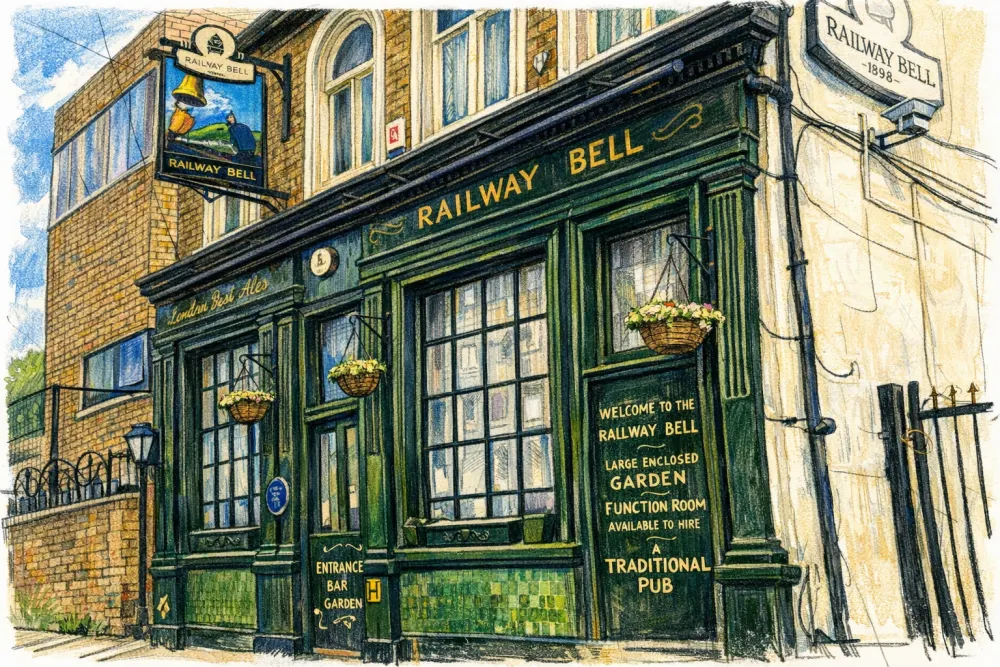
The struggle over the future of the Railway Bell is not simply a dispute about a single public house. It belongs to a much longer history in Britain in which pubs have stood at the centre of neighbourhood life, collective memory and civic association. Across towns, villages and urban districts, communities have repeatedly confronted the closure, demolition or speculative redevelopment of buildings that once served as anchors of everyday social life. In response, they have developed a remarkable range of legal, financial and collective strategies to defend them.
What emerges from these struggles is an important lesson. Historic pubs survive most securely not merely when they are listed or temporarily protected through planning refusal, but when communities succeed in embedding them once again within the social and economic life of the places around them.
The recent refusal affecting the Railway Bell therefore matters greatly. Yet it should be understood not as the conclusion of a campaign, but as the opening of a new and more difficult phase: the work of stewardship, organisation and long term public protection.
The Public House as Civic Infrastructure
The British public house has historically been far more than a venue for alcohol consumption. Pubs functioned as meeting places, informal labour exchanges, music venues, coaching inns, debating spaces and centres of local association. In industrial and railway districts especially, they often emerged in direct relationship to stations, workshops, depots and working communities.
Buildings such as the Railway Bell formed part of the social architecture of everyday urban life. Their names frequently reflected the infrastructure around them: the railway, the engineer, the foundry, the dock or the signal box. Even where interiors have changed over time, these buildings still preserve fragments of local continuity that newer forms of development rarely reproduce.
The loss of such buildings is therefore not merely architectural. As Lewis Mumford argued throughout his writings on the modern city, urban civilisation depends upon institutions capable of sustaining human association at a civic scale. Cities become socially impoverished when their spaces are reduced solely to circulation, extraction and speculative value. Historic pubs long performed the opposite role. They acted as places where neighbourhood life became visible to itself.
When these buildings disappear, streets lose more than commercial premises. They lose memory, familiarity and continuity. The process is often gradual: closure, vacancy, managed decline, claims of “non viability,” and finally redevelopment framed as inevitability.
Across Britain, communities have increasingly resisted this trajectory.
Redevelopment, Financialisation and the Fragility of Community Space
The pressures facing historic pubs today cannot be separated from wider changes in the political economy of British cities. Rising land values, speculative redevelopment and the financialisation of urban property have altered how buildings are evaluated. Increasingly, social value is displaced by development yield.
Under these conditions, pubs often become vulnerable precisely because they occupy valuable sites while generating comparatively modest returns.
The work of Anne Minton has repeatedly examined how contemporary urban development risks transforming cities into landscapes governed primarily through property logic, investment flows and managed consumption. Buildings whose value lies in public association rather than maximum commercial extraction become exposed within this system.
Historic pubs frequently fall into this category. Their importance is civic and cultural before it is financial. Yet planning debates often assess them through narrow viability frameworks that fail to account for their role within the social ecology of neighbourhoods.
The danger is not simply demolition itself. It is the gradual erosion of spaces where unstructured public life can still occur.
Jane Jacobs and the Life of the Street
Few thinkers understood this better than Jane Jacobs. Writing against the large scale clearance schemes of the twentieth century, Jacobs argued that healthy urban neighbourhoods depend upon dense networks of ordinary interaction built slowly through repeated public encounter.
Historic pubs often function as precisely these kinds of social anchors. They create familiarity between neighbours, sustain informal social contact and contribute to the everyday rhythms through which communities recognise themselves.
Jacobs understood that cities derive resilience not from abstract masterplans but from accumulated habits of association. Once the places that sustain those habits disappear, they are rarely recreated successfully through top down redevelopment alone.
This is one reason why communities so often mobilise around threatened pubs even when they may not use them regularly themselves. Such buildings frequently embody a wider sense of local continuity that extends beyond individual consumption.
The Emergence of Modern Community Pub Protection
Over recent decades, campaigners across Britain have developed a sophisticated set of tools for defending threatened pubs. These efforts combined planning law, heritage protection, community fundraising, cooperative ownership and public campaigning.
One of the most influential organisations in this field has been CAMRA (Campaign for Real Ale), whose work gradually expanded beyond consumer advocacy into broader campaigns for pub preservation and community ownership. Alongside this emerged the work of organisations such as The Plunkett Foundation and Co-operative UK, both of which helped communities establish cooperative structures capable of purchasing and operating threatened buildings.
These campaigns demonstrated something important. Legal protections alone are rarely sufficient. A listed pub can still close. A refusal decision can later be overturned. Long term survival depends upon organised stewardship and viable public use.
Historic Examples of Successful Protection
The Ivy House, South London
One of the most significant modern precedents is The Ivy House in Nunhead.
Threatened with redevelopment following closure, the building became London’s first community owned pub purchased through a public share offer. Residents organised collectively, established a cooperative structure and secured the building for long term community use.
The significance of the Ivy House lay not only in the rescue itself, but in the model it established. Communities could move beyond reactive objection and create durable ownership structures capable of protecting buildings directly.
The Chesham Arms, Hackney
The Chesham Arms provides another important example.
After closure and proposed conversion to housing, residents organised a sustained campaign involving petitions, planning objections, heritage advocacy and Asset of Community Value registration. The campaign ultimately succeeded in preventing redevelopment and the pub later reopened.
The case demonstrated how organised public pressure could reverse assumptions that closure automatically justified residential conversion.
The George Tavern, Stepney
The survival of The George Tavern illustrates a further lesson.
Dating partly from the seventeenth century, the building survived repeated redevelopment pressure through a combination of heritage campaigning, cultural programming and public advocacy. Rather than functioning solely as a traditional pub, it expanded into music, performance and community activity, strengthening both its economic resilience and its public role.
Increasingly, successful pub preservation depends upon this kind of adaptive civic use.
Asset of Community Value Protection
One of the most important modern mechanisms for protecting pubs has been registration as an Asset of Community Value under the Localism Act 2011.
Although ACV status does not permanently prevent sale or redevelopment, it establishes formal recognition that a building contributes to community wellbeing and social life. It can also delay disposal, allowing communities time to organise funding, campaigns or acquisition strategies.
Many successful pub campaigns have used ACV status strategically alongside heritage and planning arguments.
For buildings such as the Railway Bell, such protections are often important defensive measures, though rarely sufficient on their own.
Funding, Grant Support and Community Action
Communities seeking to protect historic pubs often discover very quickly that enthusiasm alone is insufficient. Even relatively modest conservation projects can require architectural surveys, legal advice, planning consultants, structural reports, roof repairs, accessibility works, business planning and fundraising expertise. Where buildings have suffered prolonged vacancy or managed decline, the financial challenges can become substantial.
Yet the history of successful pub preservation demonstrates that communities are often far more resourceful than developers or local authorities initially assume.
Readers seeking active heritage funding bodies and grant providers can explore the ConserveConnect Funding Organisations Directory, which includes organisations supporting conservation, restoration and community heritage initiatives across the United Kingdom.
Projects requiring assistance with conservation funding research, grant preparation or specialist support can also explore the ConserveConnect Grant Support Service, which aims to connect historic building projects with conservation professionals, restoration expertise and funding pathways.
Historically, campaigns protecting pubs and community buildings have tended to succeed when they combine several forms of support simultaneously rather than relying upon a single funding stream.
Community Share Offers and Cooperative Ownership
One of the most important developments in recent decades has been the rise of community share offers. Under this model, residents collectively purchase withdrawable shares in a cooperative or community benefit society established specifically to acquire and operate a threatened building.
This structure has proven remarkably effective because it transforms passive supporters into active stakeholders. Ownership becomes distributed across the community itself rather than concentrated in speculative hands.
The survival of the Ivy House demonstrated the wider possibilities of this model. Residents raised substantial funds through public share investment and secured the building as a permanent community asset. Similar approaches have since been adopted across Britain, particularly in villages where the loss of the final remaining pub would fundamentally alter local social life.
In many rural areas, community owned pubs now function not merely as pubs, but as hybrid civic institutions incorporating cafés, post offices, libraries, local food provision and meeting spaces. This diversification has often proven essential to long term sustainability.
The broader lesson is important. Buildings survive most securely when communities possess both emotional attachment and institutional power.
Heritage Grants and Specialist Funding
Many successful preservation campaigns also combine local fundraising with heritage and regeneration funding.
Bodies such as The National Lottery Heritage Fund, Historic England and The Architectural Heritage Fund have historically supported projects involving historic public buildings, conservation repairs, adaptive reuse and community ownership structures.
Funding, however, rarely arrives automatically. Successful applications typically require a coherent public vision for the building’s future. Grant bodies increasingly seek evidence that projects will generate broad social value rather than simply preserve fabric in isolation.
This is why the most persuasive campaigns often frame pubs not merely as commercial premises but as forms of social infrastructure.
A community seeking to protect a building such as the Railway Bell may therefore need to think simultaneously about conservation, programming, governance, financial sustainability and public access.
How will the building be used throughout the week? Could upper floors support cultural or workspace functions? Could local railway history be interpreted within the building itself? Could educational partnerships emerge? Could a cooperative structure unlock future grant opportunities unavailable to speculative ownership?
Increasingly, successful heritage projects answer these questions before redevelopment pressures return.
Campaigning, Public Visibility and Narrative
Historic pub campaigns also succeed because they generate public visibility and narrative continuity.
Developers and speculative owners frequently rely upon exhaustion, delay and fragmentation. Buildings are allowed to deteriorate. Communities are encouraged to believe that decline is irreversible. Closure is reframed as inevitability. The building slowly disappears from public consciousness before formal redevelopment begins. Successful campaigns interrupt this process.
Across Britain, communities have used petitions, oral history projects, exhibitions, press coverage, public meetings and archival research to demonstrate that threatened pubs possess continuing civic importance.
The campaign surrounding the Chesham Arms succeeded partly because residents refused to allow closure to become socially normalised. The building remained publicly visible throughout the dispute. It continued to exist symbolically as a pub even while physically closed.
Once a building ceases to occupy public imagination, it becomes far easier for redevelopment proposals to present demolition or conversion as pragmatic inevitabilities rather than political choices.
The preservation of historic pubs therefore depends not only upon legal tools and funding structures, but upon the defence of public memory itself.
Building Coalitions Beyond the Pub
One of the most striking characteristics of successful preservation movements is that they often expand beyond traditional pub users alone.
Campaigns frequently draw support from local historians, conservationists, musicians, artists, railway heritage groups, architects, planners and residents concerned more broadly with the erosion of public space.
This widening coalition is essential because the issue ultimately concerns the character of urban life itself.
As Jane Jacobs understood, cities derive vitality from layered networks of ordinary interaction distributed across streets, corners and neighbourhood institutions. When those institutions disappear, social fragmentation tends to follow.
Likewise, the work of Lewis Mumford reminds us that cities cannot remain healthy when all questions of value are subordinated to speculative land economics alone. Human settlements require institutions that sustain civic continuity across generations.
Buildings like the Railway Bell matter because they continue to embody this continuity materially within the city itself.
Heritage Protection Must Be Paired with Use
One of the central lessons emerging from successful preservation campaigns is that vacant heritage remains vulnerable heritage.
Many historic pubs survive initial redevelopment threats only to enter prolonged periods of underuse, managed decline or partial dereliction. Over time, this condition itself becomes weaponised. Empty buildings are repeatedly presented as evidence that continued public use is unrealistic, allowing speculative redevelopment to return in new forms.
For this reason, the long term protection of historic pubs increasingly depends upon establishing viable and active civic futures rather than relying solely upon defensive planning arguments.
The survival of the George Tavern demonstrates this particularly clearly. Its continued existence owes much to the way the building evolved into a broader cultural institution incorporating music, performance, heritage and community activity alongside traditional hospitality use. Rather than freezing the building as a static relic, campaigners and operators allowed it to remain socially alive.
Historic pubs were never historically valuable because they remained unchanged. They mattered because they adapted continuously to the life around them while preserving continuity of place.
A successful future for the Railway Bell may therefore require imaginative hybrid use rather than a narrowly nostalgic restoration model. The building could potentially support multiple overlapping functions simultaneously: a functioning public house or café space, railway heritage interpretation, community meetings, music and cultural programming, educational events, workspace or studio use, exhibitions or local history projects. The crucial point is that active civic use generates political resilience.
A building that hosts meetings, performances, exhibitions and daily public activity becomes much harder to erase than one surviving merely as a protected shell.
The Danger of Facadism and Symbolic Preservation
There is also a growing danger that preservation becomes reduced to symbolic retention alone.
Across Britain, numerous historic pubs have undergone forms of partial preservation in which façades survive while interiors disappear entirely. Elsewhere decorative references to former public houses remain while the building’s social function vanishes altogether.
This process often produces the illusion of continuity while destroying the civic life that once gave the building meaning.
The issue therefore extends beyond architecture. It concerns whether places historically designed for public association continue to function publicly at all.
A city filled with preserved façades but stripped of communal institutions risks becoming historically decorative yet socially hollow.
Use Creates Constituencies of Protection
Historic pubs have historically proven resilient because active use creates constituencies of defence.
A building regularly inhabited by residents, musicians, organisers, historians and community groups develops overlapping networks of attachment. These networks often become decisive during future planning disputes.
This is why many successful preservation campaigns focus quickly upon reopening buildings in some form even before long term restoration is complete. Temporary events, meanwhile use and public programming help prevent symbolic disappearance.
Once a building returns to daily public life, arguments for demolition or conversion become politically far more difficult.
The challenge facing the Railway Bell is therefore not solely one of conservation, but of re establishing durable public relevance within the neighbourhood itself.
From Refusal to Stewardship
The refusal affecting the Railway Bell matters because it interrupts a trajectory that might otherwise have resulted in permanent loss. Yet planning refusals alone rarely secure the future of threatened buildings indefinitely.
Ownership structures change. Economic conditions shift. New applications emerge. Speculative pressure returns in altered forms. The longer term question is therefore fundamentally institutional rather than procedural.
What kind of civic structure can protect the building permanently? Who should shape its future? What forms of ownership best resist speculative redevelopment? How can economic sustainability be reconciled with public value?
Across Britain, communities have answered these questions differently. Some established community benefit societies capable of collective ownership. Others secured long leases through charitable trusts or cooperative structures. Some developed partnerships with local arts organisations, conservation groups or independent operators committed to public programming.
Increasingly, the most resilient projects combine several elements simultaneously: heritage protection, community governance, diversified income streams, cultural programming, public accessibility and long term stewardship structures.
This reflects a broader historical reality. Public houses survived for centuries not simply because they were commercially profitable, but because they fulfilled multiple social functions simultaneously.
Stewardship Rather Than Extraction
The debate surrounding buildings like the Railway Bell reflects a wider conflict between two competing models of urban development.
One treats land primarily as a financial asset whose highest purpose lies in maximising exchange value. Under this logic, older buildings survive only when they can justify themselves economically against alternative forms of development.
The other understands cities as accumulations of social memory, public association and shared civic inheritance. Within this framework, buildings possess value not solely because of what they can financially yield, but because of the forms of life they help sustain.
The language of stewardship emerges from this second tradition. Stewardship implies continuity across generations. It suggests obligations extending beyond immediate return. It frames buildings not simply as commodities but as inherited civic responsibilities.
This is why campaigns surrounding historic pubs often become emotionally powerful. People recognise instinctively that once such places disappear, the forms of social life attached to them rarely return in equivalent form.
The Need for Organised Civic Capacity
Yet sentiment alone is insufficient. Communities seeking to protect buildings like the Railway Bell increasingly require organised civic capacity: legal understanding, fundraising structures, planning expertise, communications strategies and institutional coordination.
The most successful preservation campaigns therefore operate simultaneously at several levels: cultural, political, financial, architectural and organisational. They build public legitimacy while also constructing practical mechanisms for long term survival.
The history of pub preservation in Britain demonstrates repeatedly that communities are capable of this work when sufficient organisation emerges.
The question now facing the Railway Bell is whether the current moment of protection can evolve into something more enduring: a stable civic future rooted not simply in opposition to demolition, but in the active reconstruction of public life around the building itself.
Coda
Buildings such as the Railway Bell survive because successive generations decide that continuity matters, and because communities recognise that cities require places where memory remains materially present within everyday life.
The greatest threat facing historic pubs today is not simply demolition. It is the wider transformation of urban land into an increasingly financialised landscape organised primarily around speculative return.
Yet the history of pub protection in Britain also reveals something hopeful. Communities have repeatedly shown themselves capable of organising sophisticated responses. They have learned to use planning law, heritage policy, cooperative finance, public campaigning and collective ownership in defence of local institutions.
The future of the Railway Bell will depend upon whether such energy can now be consolidated into a durable civic project: one capable of protecting the building not merely as an object of memory, but as an active and living part of the public life of the city.