
The Refusal
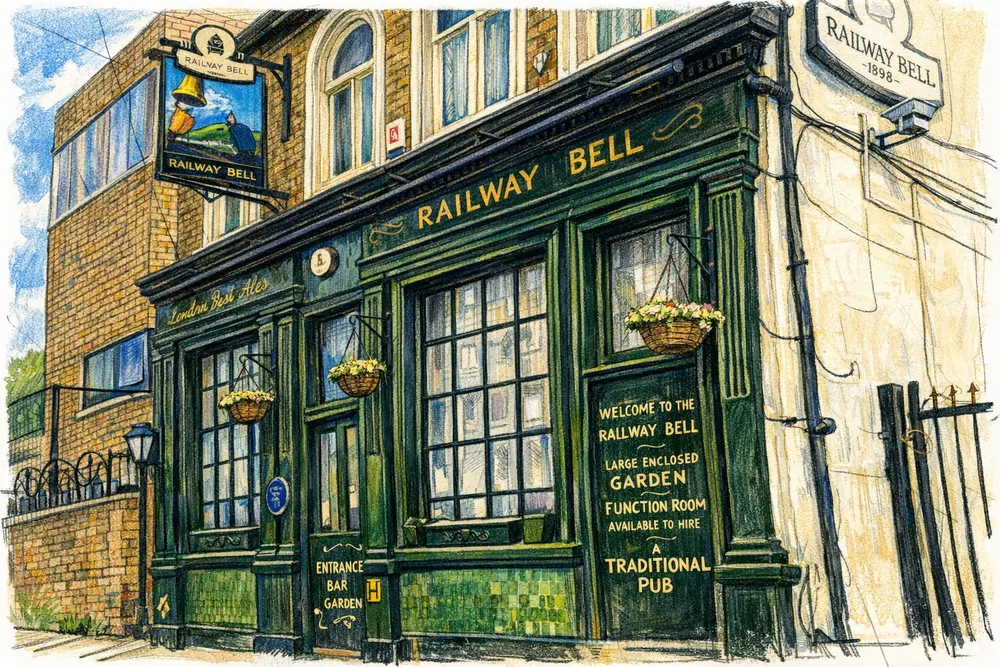
On 17 April 2026, Lambeth refused planning permission for the Railway Bell at 14 Cawnpore Street, Gipsy Hill. The proposal was for the “Construction of nine 1 bedroom apartments, associated private and communal amenity, bin and bike store, with the retention of the existing Railway Bell pub frontage. Demolition of the existing pub structure and outbuildings with retention of the pub frontage.”
What has been refused, then, is not merely one more indifferent scheme. What has been refused is a familiar method: strip a place of its life, preserve enough of its outer skin to soften resistance, and call the result renewal.
The importance of this decision lies in the fact that Lambeth has now recognised, in formal planning terms, what residents and supporters have argued throughout: the Railway Bell has heritage, cultural, economic and social value, and its loss has not been justified. The Council says so plainly.
“In the absence of a robust marketing report, it has not been demonstrated that the use of the site as a public house (Sui Generis), which has been identified to have heritage, cultural, economic and social value, is not viable, nor has it been demonstrated that other community uses have been explored.”
That finding should not be treated lightly. Nor should it be treated as the end of the matter. It is better understood as the point at which the argument enters a new phase. For the question is no longer simply whether this particular scheme was unacceptable. The question is what follows once it has been established that the building’s value is real, that its public loss has not been justified, and that it cannot simply be emptied of historic purpose and reduced to a frontage.
What the Decision Has Established
The first refusal reason goes to the centre of the case. There is no need to embellish it. The wording is already strong enough. The Council did not accept that the public role of this building could simply be discarded as a nuisance standing in the way of development. It found that the case against continued pub use had not been made, and that other community uses had not been properly explored. It concluded, further, that
“The proposed loss of the public house use (Sui Generis) would be contrary to Policies ED9 of the Lambeth Local Plan (2021), HC7 of the London Plan (2021) and the Lambeth Marketing of Commercial Premises and Sites Guidance Note (2023), and would cause adverse impacts to the local community.”
That matters greatly. It means the Railway Bell has not been treated as a neutral shell or redundant plot, but as a place whose public role carries planning weight.
The ruling goes further still. Lambeth found that, “By reason of the substantial demolition of a locally listed building (non-designated heritage asset) and the introduction of unsympathetic contemporary alterations to the building, and by reason of the position of the proposed cycle and bin storage, the proposal would cause harm to the significance of the locally listed public house which has not been justified or outweighed.”
Here one touches a larger habit of our time. A place is emptied, pared back, hollowed out, and then returned to the street as a kind of visual apology. Enough remains to suggest continuity, while the life of the building itself has been taken away. This is offered as preservation. It is not preservation. It is the management of loss.
Lambeth did not accept that bargain. It did not mistake the survival of an image for the survival of a place.
Nor was the refusal built on some narrow failure of presentation. The Council also found that “It has not been demonstrated that the proposal would provide high quality residential accommodation.” It noted insufficient information on floor to ceiling heights, the failure of Apartment 1 to meet minimum space standards, the absence of a daylight and sunlight assessment, unresolved flood risk to basement bedrooms, and the exposure of front garden space on public highway land. It added, with notable bluntness, that “The majority of the apartments would have insufficient levels of outlook and would be adversely overlooked.”
This is worth dwelling on for a moment, because it tells us something about the wider pattern in which such schemes now appear. Too often the language of regeneration arrives wrapped around a much poorer substance: heritage diminished, public life extinguished, and mediocre housing offered as the price of acquiescence.
What the Railway Bell Represents
It would be a mistake to think that the Railway Bell matters only because it is locally listed, or because part of its fabric survives from an earlier period, or because its frontage contributes to the street. All this is true, but it is not enough. Buildings of this kind matter because they belong to the lived order of the city. They are among those recurring places through which neighbourhood life acquires shape, memory and recognisable form. People do not experience them as isolated objects. They experience them as part of the ordinary architecture of belonging.
A place like the Railway Bell is valuable not only because it has stood, but because it has been used, recognised, returned to, and woven into the social memory of the area.
That is why the rhetoric of retention so often conceals more than it reveals. A frontage may remain and yet the building may be lost in every way that matters. The old face is preserved; the inner life is cut away. What is then presented as continuity is often only a likeness of continuity, a staged resemblance designed to carry legitimacy from one order of use into another. A building can be kept as image while being destroyed as institution.
This refusal matters because it resisted precisely that manoeuvre. The Council has recognised that the value of the Railway Bell is not exhausted by outward appearance. It lies also in use, in memory, in social function, in the fact that this was not merely a structure on a site but a public place in a neighbourhood.
The Wider Condition
And here the matter widens. The loss of places like the Railway Bell is not only a question of demolition in the crude physical sense. It belongs to a larger thinning of the public city, a gradual narrowing of those places in which informal and shared urban life may still occur. What disappears is not merely a building type, but a social possibility. The public house, at its best, has long been one of those institutions in which ordinary encounter could happen without ceremony and without programme, where presence did not first have to justify itself.
Once such places go, they are rarely replaced by anything equal to them. What comes instead is often more managed, more monetised, more carefully filtered by the private logic of return. The vocabulary may be contemporary, the materials carefully chosen, the renderings softened by the usual promises of activation and enhancement. But what is produced is too often a thinner city, one in which publicness survives only in diminished and supervised form.
That is why the Railway Bell matters beyond the limits of a single planning file. What was threatened here was not simply a building, but one small part of the social ground on which urban life depends.
The refusal therefore establishes something more than a pause. It sets a benchmark on this site. Not a precedent in the strict legal sense, but a benchmark nonetheless. Lambeth has now accepted the building’s social and heritage value and has refused its unjustified erasure. Any future scheme will have to contend with that. It cannot return innocent of what has already been decided.
What Must Now Be Secured
Yet it would be naïve to mistake refusal for safety. Buildings may be lost by attrition as surely as by demolition. Vacancy, neglect, managed decline, speculative waiting, the slow construction of a narrative in which all alternatives are said to have failed: these are among the familiar means by which a public asset is made available for private redefinition.
If the Railway Bell is to remain secure to the local community, it will not be enough merely to have stopped one harmful proposal. The task now is to secure a use capable of keeping the building alive in the life of the neighbourhood.
That means something more demanding than sentiment and something more practical than abstract preservation. Heritage without use is fragile. A cherished building left empty soon becomes vulnerable not only in material terms, but in political terms. It becomes easier to describe as a problem, easier to cast as obsolete, easier to recruit into the argument that nothing viable remains except surrender.
So the matter now turns. The question is no longer simply how this scheme was defeated. The question is what form of use can now sustain the building in a way adequate to its history and its place. The starting point must be plain enough. The Railway Bell was designed as a public house, a place of gathering, an institution of repeated local life. That fact should not be treated as incidental. It should shape the discussion from the outset.
If continued or restored pub use is viable, it should be pursued with seriousness. If another model is considered, it should still be one that serves the community in a real and durable way, one that respects the building’s public and historic character rather than treating heritage as an attractive outer layer for some wholly different economic logic.
What is required is not the preservation of a picturesque remnant, but the recovery of a place capable of sustaining public life in substance.
The Next Steps
That recovery will not happen by sentiment alone. It requires organisation, legal protection, a viable use case, and a public body capable of carrying the matter forward.
The first task should be to seek Asset of Community Value status without delay. Lambeth’s ACV regime exists precisely for buildings and places judged to have community value, and a successful listing remains on the register for five years, with the council also recording a local land charge and arranging for a restriction to be entered on the Land Registry title. For a building which Lambeth has now expressly recognised as possessing heritage, cultural, economic and social value, the case is obvious. ACV status will not solve everything, but it will strengthen the public position, formalise the building’s community significance, and make it harder for the next phase to unfold quietly.
The second task is to give the campaign a durable legal and organisational form. A loose alliance of supporters can win an argument. It cannot easily hold an asset, apply for grants, negotiate leases, raise community finance, or prepare a credible bid if the building is ever offered for sale. A community benefit society, charitable body, or similar vehicle should therefore be considered. The exact structure may be decided later. The essential point is that the community should not remain merely reactive. It should become capable of stewardship.
Third, the community should now do what the applicant failed to do. It should assemble a serious viability and reuse case. Lambeth has already found that it was not demonstrated that pub use was unviable, and that other community uses had not been properly explored. That is not merely a criticism of the applicant. It is an opening. The community can now reverse the burden in practical terms by commissioning or preparing a short but credible options study: restored pub use, pub with events and food, pub with cultural or meeting space, or another genuine community-serving model. The point is to shift from protest to proposition.
Fourth, a positive public brief should be articulated and repeated. The Railway Bell should not merely be protected from harm. It should be secured for active use as a place of gathering, hospitality, culture and neighbourhood life. Even if the final model is not identical to its historic use, it should remain consonant with the building’s design, history and social meaning. The goal is not to preserve a shell. The goal is to preserve and renew a public institution.
Fifth, the site should be monitored carefully for neglect, unauthorised works, or the slow manufacture of decline. Many valued buildings are not lost in one decisive blow, but by wear, vacancy, unmanaged deterioration, and the later argument that decay itself makes demolition reasonable. That process must be anticipated early, documented carefully, and challenged promptly.
Sixth, Lambeth’s political leadership and local representatives should now be pressed to state in writing that the future of the Railway Bell must begin from the refusal decision already made. Ward councillors, the local MP, and relevant cabinet figures should be asked to support not merely the refusal of harmful development, but the principle of viable and lasting community use. The issue should be fixed publicly before it is softened privately.
Seventh, the heritage case should be strengthened wherever possible. The refusal already treats the building as a locally listed non-designated heritage asset. But fuller documentation of its history, social use, public significance and architectural integrity will still matter. The stronger the record, the harder it becomes to revive the old logic under new packaging.
Eighth, the possibility of sale or transfer should be prepared for in advance rather than in panic. Lambeth explains that where an ACV-listed asset is proposed for disposal, the community right to bid process can trigger a moratorium that gives community groups time to organise. That time is only useful if preparation has already begun. A community vehicle, an outline business plan, possible operating partners, early conversations with funders, and a provisional prospectus should all be developed before any such moment arrives.
Ninth, a public prospectus should be assembled. It need not be elaborate. It should simply state the history of the building, the significance recognised in the refusal, the case for renewed public use, the possible operating model, and the basic route to long-term security. Such a document would help unify supporters, reassure politicians, attract partners, and demonstrate seriousness.
Finally, the strategic aim should be stated clearly. The real objective is not perpetual reaction to each new scheme. It is some durable form of public control or public guarantee: ownership, leasehold control, binding covenant, trusted operator arrangement, or another mechanism sufficient to keep the Railway Bell in genuine community-serving use. Consultation alone is not security. Objection alone is not stewardship. The building will be safe only when its future is materially harder to separate from the public life that gives it meaning.
The Task Ahead
The future of the Railway Bell should not be invented against the grain of the building, nor against the memory of the site, nor against the social needs that first made such a place valuable. Good continuity does not arise from forcing a building into a role alien to its form and history. It arises when a place is allowed to carry forward something of what it already is, while answering present needs in a way the locality can recognise as its own.
That is why the decision matters so much. Lambeth has already said enough to orient the discussion that must now follow. It has said that the loss of the building’s public function has not been justified. It has said that its heritage value is real. It has said that the proposal before it fell short. These are not incidental findings. They are the frame within which every future proposal must now be judged.
It will not be enough for an applicant to return with smoother language, softer drawings or a rearranged housing mix. The essential questions have already been brought into view. Has pub use genuinely been tested? Have alternative community uses genuinely been explored? Is the building being conserved in substance or merely represented in image? Is the future being proposed one that serves the area, or one that extracts value from a recognised local asset?
These are no longer secondary questions. They now stand at the centre of the case.
There may yet be an appeal. There may yet be revision, delay, a long effort to convert fatigue into consent. That is why this moment should not be allowed to dissolve into relief alone. It should be used to consolidate a public position: that the Railway Bell has been recognised as a building of real community and heritage value; that its loss has not been justified; and that its future must now be secured in terms not of cosmetic retention, but of viable and lasting community use.
Coda
In the end, Lambeth’s refusal confirms something that ought never to have required so much argument. The Railway Bell is not an empty development opportunity draped in historic brick. It is a place with heritage, cultural, economic and social value, and its public loss has not been justified.
The Railway Bell has been saved for now. The task ahead is to ensure that it is not merely left standing, but secured in viable, lasting and community serving use.
That is how local history remains alive: not as ornament, not as frontage, not as the image of continuity after continuity has gone, but as a place still capable of being lived. And that is the standard by which whatever comes next should now be judged.