

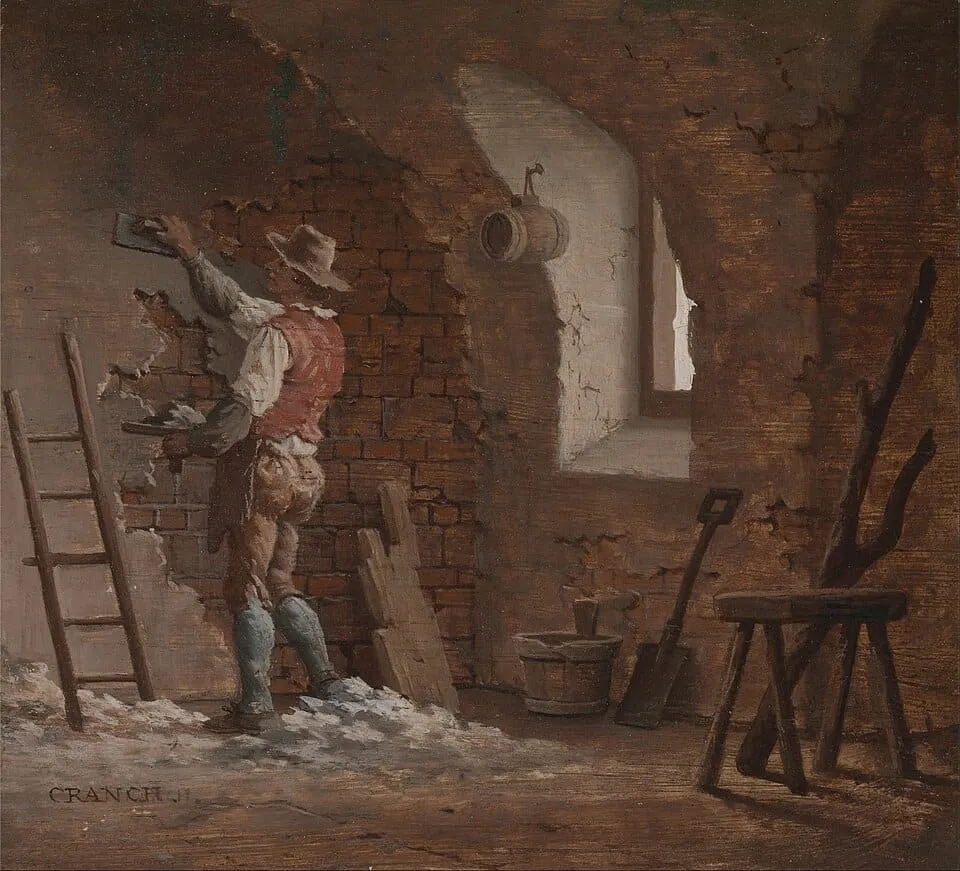
The revival of traditional plastering is not nostalgia. It is a practical response to damp, building failure, lost craft knowledge and the renewed understanding that old buildings need compatible materials, patient repair and skilled judgement.
For much of the twentieth century, plastering was treated as a trade that modern construction had largely solved. Walls could be boarded, skimmed, painted and made flat with speed and regularity. Decorative work could be cast elsewhere and fixed in place. Older methods — lime putty, haired plaster, timber laths, slow carbonation, hand-run mouldings, pargeted surfaces, exterior stucco and polished scagliola — appeared to belong to another age.
Yet that older world has not disappeared. It remains in the walls, ceilings and interiors of thousands of historic buildings. It survives in the soft undulation of a limewashed medieval wall, in the nibs of a lath-and-plaster ceiling, in the ribs of a Jacobean ceiling, in the texture of a pargeted façade, in the smooth authority of Regency stucco and in the deep polish of scagliola columns that imitate rare stone while remaining unmistakably the work of plaster.
The modern revival of traditional plastering has not arisen from sentiment alone. It has been forced upon us by the buildings themselves. Old walls repaired with hard, impermeable or incompatible materials have cracked, sweated, trapped moisture or encouraged mould. Ceilings that appeared sound have proved vulnerable where hidden fixings, fibres or timber supports have failed. Historic interiors overpainted, over-skimmed or stripped without understanding have shown how easily the wrong repair can damage the thing it seeks to improve.
Traditional plastering is therefore returning not as a decorative fashion, but as a necessary form of building knowledge.
More Than a Finish
Plaster is often treated as background: the surface before the paint, the thing to be made flat before the room is considered complete. In historic buildings this is a serious misunderstanding.
Plaster is not merely a finish. It is a technical skin, an environmental buffer, a structural participant, a decorative medium and a record of craft.
A lime-plastered wall may be absorbing and releasing moisture. A haired plaster ceiling may depend for its survival on the integrity of timber laths, plaster nibs and animal hair embedded more than a century ago. A decorative ceiling may contain cast gypsum, hand-modelled lime, armatures, paint layers, limewash, distemper, earlier repairs and later over-painting. A stucco façade may be performing as both architectural image and weathering surface.
To understand plaster properly, one must read the building rather than simply apply a product to it.
This is why the revival of traditional plastering matters. It is not merely a return to older materials. It is a return to judgement.
How Speed Displaced Skill
The decline of traditional plastering was not only a change in material. It was a change in the organisation of work.
Modern plasterboard, gypsum skims, ready-mixed products and workshop-cast decorative components made construction faster and more predictable. They also narrowed the range of skills expected of the plasterer. Where older plasterers might have understood lime, lath, suction, shrinkage, aggregates, hair reinforcement, hand-run mouldings and in-situ repair, modern training too often prepared workers for a much narrower world of board-and-skim work.
That narrowing has consequences. Historic buildings do not always need speed. They need compatibility, patience and informed handling. They need plasterers who can understand the substrate, read the existing work, control drying, match aggregates, repair edges, reinstate mouldings and know when not to intervene.
The question is not whether modern plastering has its place. It plainly does. The question is whether modern assumptions have become so dominant that we have forgotten how to care for buildings made under very different conditions.
Breathability Without Slogans
The word “breathability” is often used loosely in conservation. It should be used carefully.
Walls do not breathe like lungs. What traditional building materials often do is manage moisture differently from many modern systems. Lime plaster, lime render, limewash, soft brick, stone, earth, timber and traditional mortars can absorb, release and buffer moisture. They allow water vapour to move. They can also tolerate modest movement and localised damp in ways that harder, less permeable systems often cannot.
This is one reason lime plaster has returned to prominence. The case for lime is not romantic. It is based on the recognition that many old buildings have suffered when coated or repaired with inappropriate materials. Trapped moisture, salt movement, mould growth, failed finishes and decaying fabric are not abstract conservation concerns. They are practical symptoms of a building being made to behave in a way its fabric cannot support.
But breathability should never become a magic word. Lime plaster used badly can fail. A vapour-permeable coating applied over an impermeable system may achieve little. A “traditional” specification copied without understanding can be as damaging as a modern one.
Moisture movement must be understood in relation to the whole wall: substrate, plaster, finish, ventilation, heating, salts, previous repairs and water ingress. The wisdom of traditional plastering lies not in a slogan, but in its capacity to work with the building rather than against it.
Lime, Gypsum and the Danger of False Oppositions
One of the most important lessons from serious plaster conservation is that simple oppositions are misleading. Lime is not always right. Gypsum is not always wrong. Traditional plastering has always been more varied than modern debates sometimes allow.
Decorative plasterwork, in particular, is often a story of both lime and gypsum. Lime is slow-setting, versatile and capable of modelling and adjustment. Gypsum sets rapidly and is particularly suited to casting. In many historic decorative schemes, the two materials were used side by side, each chosen for particular qualities.
This matters because a conservation-led plaster revival cannot simply say “use lime”. It must ask: what is already there? Is the plaster lime, gypsum, earth, gauged lime, fibrous plaster, Keene’s cement, mastic, scagliola or something more complex? Is it plain work, run work, cast enrichment, hand-modelled ornament or structural ceiling fabric? Is it damp? Is it salted? Has it been over-painted? Has it moved? Has it failed before?
The wrong repair can be technically plausible and still be historically and physically inappropriate.
The Craft Is in the Evidence
Traditional craft is not recovered through romance. It is recovered through close observation, testing, failure and adjustment.
The repair of historic plasterwork often begins with evidence that a hurried eye would miss: scratched setting-out lines, tool marks, rib profiles, lath spacing, aggregate size, hair distribution, paint layers, hollow-sounding areas, earlier repairs and subtle changes in texture. Old plaster is a document. It records the plasterer’s hand, tools, sequence of work, material choices and tolerance for irregularity.
A rib that looks crude to a modern eye may reveal a sophisticated method of setting out. A slightly uneven finish may be characteristic of the period. A crack may be a sign of structural movement, shrinkage, later alteration, poor maintenance or previous repair.
Modern conservation must therefore resist the urge to over-perfect. Historic plasterwork often contains movement, variation and liveliness. To flatten it into modern regularity may be to erase part of its meaning.
Decoration Is Not Superficial
The revival of traditional plastering also matters because plaster is one of Britain’s great decorative arts. It ranges from the humblest cottage wall to the most elaborate country house ceiling. It includes Tudor and Jacobean strapwork, Georgian cornices, Rococo modelling, Regency stucco, pargeted façades, theatre ceilings, scagliola columns and fibrous plaster ornament.
Plaster can imitate stone, marble, wood, metal, carving and textile. It can be modelled, pressed, cast, run, scratched, polished, limewashed, painted or gilded. It can be modest and regional, or theatrical and spectacular.
Pargeting turns exterior plaster into local identity and public ornament. Scagliola transforms gypsum plaster, pigments and polished surfaces into the illusion of rare stone. Fibrous plaster allowed theatres and music halls to create extraordinary decorative interiors at reduced weight and cost. Exterior stucco enabled whole façades to simulate fine stonework and produce the architectural character of Regency and early Victorian streets.
These are not marginal crafts. They are part of the visual and social history of place.
The Hidden Side of Plaster
One reason plaster is so often mishandled is that much of what matters is hidden. The visible surface may tell only part of the story. Behind it may be timber laths, nibs, hessian ties, ferrous armatures, timber decay, salts, failed keys, previous grouts or crude modern repairs.
The collapse of part of the Apollo Theatre ceiling in 2013 made this brutally clear. Large fibrous plaster ceilings require monitoring, inspection and specialist knowledge because hessian ties and wadding can deteriorate while appearing sound from below. Visual inspection alone is not always enough.
This has implications beyond theatres. Historic ceilings, cornices, decorative schemes and plastered walls should not be treated as inert surfaces. They are systems. Their stability may depend on roof maintenance, ventilation, timber condition, water management, access, previous alterations and the behaviour of adjoining materials.
A plaster revival that ignores maintenance is not a revival at all. It is merely a change in product choice.
Cleaning, Stripping and the Ethics of Restraint
The urge to reveal historic plaster can also be dangerous. Thick paint layers may obscure fine ornament, but their removal is irreversible. Cleaning and stripping can erase historic evidence and physically damage the underlying material, even when carried out with care. Yet excessive paint build-up can also obliterate fine detail and leave important interiors undervalued or neglected.
The issue is not whether cleaning is good or bad in the abstract, but whether the benefit justifies the risk in a particular case.
This gives the plaster revival an ethical dimension. Not every old surface should be stripped. Not every crack should be filled. Not every hollow area should be grouted. Not every sagging ceiling should be forced flat. Not every historic irregularity is a defect.
Traditional materials and like-for-like repair may be desirable, but they are not automatically sufficient. Fragile substrates, decorative coatings, previous repairs, moisture, salts and structural movement all affect what responsible conservation should mean.
Conservation is not improvement in the ordinary building-trade sense. It is an attempt to preserve significance while enabling continued use. That requires restraint.
Stucco and the Street
The revival of traditional plastering must also include exterior work. Stucco is central to the architectural character of many British streets, especially Regency and early Victorian terraces. It was often used to imitate finely dressed stone, sometimes over brick or rubble, and its repair depends on correctly identifying the original material and method.
Stucco systems vary considerably. They may involve fat lime, hydraulic lime, pozzolanic mixes, mastic systems, different aggregates, different finishes and different paint histories. Incompatible repair materials can accelerate decay rather than prevent it.
The common enemies are familiar: failed gutters, water penetration, trapped moisture, salts, hard cement repairs, impermeable paint systems and neglect. Exterior plasterwork is not low-maintenance simply because it looks solid. Its durability depends on water management and periodic care.
A street of stucco houses is therefore not only an architectural composition. It is a maintenance commitment. When owners, councils, managing agents or contractors treat stucco as if it were modern cement render, they risk losing both fabric and character.
What the Revival Requires
The revival of traditional plastering will not be secured by enthusiasm alone. It requires a whole ecosystem of support.
It requires clients who understand that old buildings need time. Lime plaster cannot always be forced into modern programme expectations. Drying, carbonation, tending and finishing all matter.
It requires specifiers who understand that “traditional” is not a single recipe. Mortar analysis, paint analysis, salt analysis, investigation from above and below, and test panels may all be needed before work begins.
It requires contractors who have both hand skill and diagnostic intelligence. The best plasterers are not simply applying material. They are reading suction, weight, texture, movement, moisture and previous workmanship.
It requires training pathways that do not reduce plastering to board-and-skim work. Traditional plasterers need to understand lime, gypsum, lath, hair, aggregates, mouldings, decorative repair, finishes and conservation ethics.
It requires procurement that values competence rather than the cheapest apparent solution. Poor plaster repair can be extremely expensive when it fails, damages original fabric or creates future moisture problems.
And it requires public platforms that make skilled practitioners visible. Owners of historic buildings often do not know where to find the right person. General building search platforms are rarely good at distinguishing between ordinary plastering, lime plastering, fibrous plaster conservation, stucco repair, pargeting, scagliola, decorative plaster and specialist ceiling stabilisation.
Repairing Forward
The return of traditional plastering is not a retreat from modernity. It is a correction to a mistaken idea of progress.
Progress in the care of old buildings does not mean replacing every slow material with a fast one, every irregular surface with a flat one, every permeable layer with a sealed system, or every hand-made detail with a standardised cast. It means understanding what the building is, how it performs and why its fabric has survived.
Traditional plastering teaches us that buildings are not just assemblies of products. They are relationships between materials, moisture, structure, craft, maintenance and time.
Its revival matters because it brings those relationships back into view.
The wisdom of traditional plastering is not that the past was always right. It is that old buildings cannot be properly repaired unless we are willing to learn from them.
Finding the Right Specialist
Traditional plastering is not one trade but a family of related skills: lime plastering, lath-and-plaster repair, decorative plaster, fibrous plaster, stucco, pargeting, scagliola, conservation cleaning and specialist ceiling stabilisation.
ConserveConnect lists practitioners and companies working in these fields, helping building owners, architects, surveyors and conservation professionals find suitable expertise for sensitive repair.
Selected Voices in Traditional Plaster Conservation
The revival of traditional plastering has been shaped by a wide field of practitioners, conservators, architects, analysts and writers. The following names are not an exhaustive canon, but they represent important strands of current knowledge.
Tim Ratcliffe
Important on lime plastering, gypsum, compatibility and the loss of traditional plastering skills.
Ian Constantinides
Important on lime plaster myths, material analysis, exterior stucco and the need to avoid formulaic repair.
Richard Ireland
Important on decorative plaster conservation, cleaning, restraint and the ethics of intervention.
Trevor Proudfoot
Important on decorative lime plaster, gypsum, modelling, casting and the relationship between material and form.
Philip A. Gaches
Important for practical conservation work on historic plaster, especially the evidence-led repair of Jacobean ceilings.
Bob Bennett
Important on haired lime plaster, laths, fibre reinforcement and the structural logic of traditional plaster.
David Harrison
Important on fibrous plaster, theatre plasterwork, scagliola and decorative plaster as architectural craft.
Ronnie Clifford
Important on the inspection, maintenance and safety of large fibrous plaster ceilings.
Sean Wheatley
Important on lath-and-plaster ceilings, defects, water damage and practical repair techniques.
Michael Koumbouzis
Important on scagliola restoration and the highly specialised craft of conserving polished plaster surfaces.
Selected Further Reading
The following texts and publications have helped shape modern understanding of traditional plastering, lime plaster, decorative plaster, fibrous plaster, stucco and scagliola. They are included as a reference shelf for readers wishing to explore the subject further.
Tim Ratcliffe, Internal Lime-Plastering
Tim Ratcliffe, The Use of Gypsum Plaster
Ian Constantinides, Traditional Lime Plaster: Myths, Preconceptions and the Relevance of Good Practice
Ian Constantinides and Lynne Humphries, Exterior Stucco
Richard Ireland, Conserving Decorative Plaster
Richard Ireland, Cleaning Decorative Plaster
Trevor Proudfoot, Decorative Lime Plaster
Philip A. Gaches, Apethorpe Hall’s Jacobean Ceilings
Bob Bennett, Lime Plaster and Render Reinforcement
Sean Wheatley, Repairing Lime Plaster Ceilings
David Harrison, Dramatic Plasterwork: Fibrous Plaster in Theatres
David Harrison, Scagliola
Ronnie Clifford, Maintaining Large Fibrous Plaster Ceilings
Tim Buxbaum, Pargeting
Michael Koumbouzis, Scagliola Restoration
Nigel Young, The Restoration of the Bear Garden, Royal Courts of Justice
Classic and Technical References
William Millar, Plastering: Plain and Decorative, 1897
John and Nicola Ashurst, Practical Building Conservation: Mortars, Plasters and Renders
Historic England, Practical Building Conservation: Mortars, Renders & Plasters
Historic Scotland / Historic Environment Scotland, Conservation of Plasterwork, Technical Advice Note 2
SPAB, technical guidance on plaster, lime, clay plaster and traditional repair