


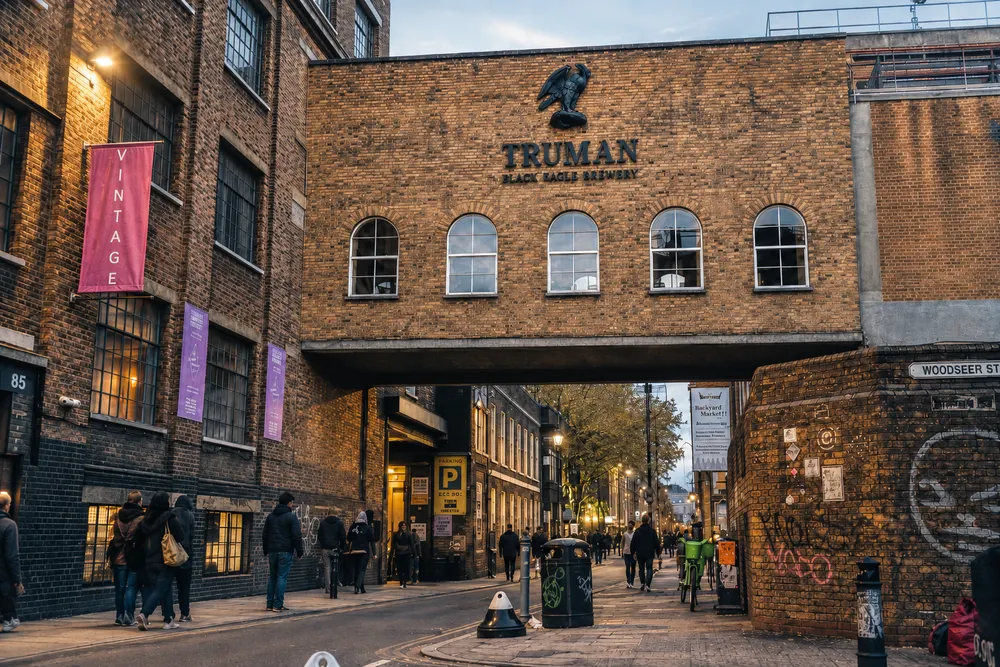
A first response to the Secretary of State’s decision
ConserveConnect.News has followed the Truman Brewery proposals closely because this has never been only a dispute about buildings. Across our Brick Lane coverage, we have examined the scheme as a test of planning power, public participation, heritage, housing need, class, land value, data infrastructure and the future of a historic working-class and migrant district.
We have argued this case in stages. In John Burrell’s Alternative Vision for Brick Lane: Regeneration Without Erasure, we considered a community-led approach to renewal based on repair, reuse and local agency rather than yield and branding. In Truman Brewery Redevelopment: Independent Analysis Finds Scheme in Breach of London Planning Law, we reported our case that the scheme was incompatible with London’s statutory planning framework. In The Conversion of Place — Data, Value and the Truman Brewery Data Centre, we examined the proposed data centre as a mechanism through which ownership, infrastructure and planning consent could convert place into asset. In Economies of Displacement: Inequality, Legitimacy, and the Truman Data Centre, we questioned the idea that regeneration is a neutral economic event. In Brick Lane, Rendered Legible to Capital, we drew together the inquiry coverage and argued that the planning process was making a lived district legible as an investable object.
Most recently, in Brick Lane, Peckham and the Political Economy of Planning, we placed the Truman Brewery appeal alongside the Aylesham Centre decision in Peckham. We asked who creates the value of a city, who owns the land through which that value is converted, who benefits from consent, who bears the loss, and what is owed back to the public from whom that value first arose. That article described planning as a process through which public need, inherited place-value, private development finance, class power and the long-term interests of existing communities are weighed against one another.
Those questions have now become urgent.
On 29 July 2026, the Secretary of State allowed all four Truman Brewery appeals. The decision grants planning permission for the proposed data centre at 47 Grey Eagle Street, the main Truman Brewery redevelopment, the Ely’s Yard commercial building, and listed building consent for works to the Boiler House. The decision was made by Matthew Pennycook MP, Minister of State for Housing and Planning, on behalf of the Secretary of State.
This is a major defeat for the campaign against the proposals. It is also a revealing document of power.
The decision accepts some heritage harm, acknowledges community concern, recognises the significant Bangladeshi population living and working in and around Spitalfields and Banglatown, and notes the emerging Tower Hamlets Local Plan allocation for a residential-led scheme. Yet it nevertheless gives limited weight to that emerging residential-led direction and gives significant weight to the data-centre need, commercial floorspace, employment generation and projected economic effects. But these are not neutral “economic benefits”. They are the claimed benefits of the development model advanced by the landowner and substantially accepted in the ruling. The decision credits the economy promised by redevelopment while giving far less force to the economy that may be damaged, displaced or priced out.
What the Ruling Confirms
Our political-economic critique has not been displaced by the ruling. It has been confirmed in the very form of the decision.
We have argued throughout that the Truman Brewery proposals should not be assessed only as a set of buildings, uses and design impacts. They should be understood as a process through which the existing value of Brick Lane — value created by labour, migration, small business, food culture, worship, markets, memory and everyday use — is translated into a higher-value development asset controlled by private land interests.
The ruling shows that process at work.
The developers’ case presented the Truman Brewery Estate as a carefully curated cultural and creative hub, and the proposed development as a way of capitalising on the area’s performance and potential. Their case described new workspace in Tech City as strengthening the London and national economy and producing a beneficial “halo” effect on the fragile local economy through increased footfall and spend.
That framing has been contested throughout.
For Save Brick Lane and many local voices, the issue was not opposition to all development. It was the kind of development being proposed, who it would serve, and what it would do to the existing social and economic life of the area. SBL argued that the emerging allocation reflected consultation with the local community and that failing to give weight to those views would represent a democratic deficit. SBL also argued that the failure to deliver more housing reflected wider failures in community engagement, inclusive design and public open space.
The Council’s own case also questioned the weight to be given to some of the claimed economic benefits. It argued that construction and operational employment and economic benefits should attract minimal weight because they would arise from most developments, and that the provision of 44 homes had to be seen alongside the failure to optimise housing delivery on the site.
The ruling nevertheless places great weight on the language of economic benefit. It accepts the appellant’s evidence of new office floorspace, projected expenditure, gross value added and job creation, and gives significant weight to employment generation and economic benefits.
This is precisely the political-economic problem. The decision does not simply find that the scheme has benefits. It privileges a particular account of benefit: one measured through new floorspace, investment, projected spend, employment estimates, Tech City positioning and infrastructure need. Against that, the existing economy of Brick Lane is treated as something that may receive a “boost”, rather than as a social and economic system that may be disrupted, diluted or displaced.
The data-centre element makes the point clearer still. The issue is not whether digital infrastructure has any social use. It plainly does. The issue is how a general need for infrastructure becomes attached to a particular privately controlled site, then becomes planning weight, then consent, then uplift, then rent.
The ruling therefore confirms the central critique we have made throughout. Brick Lane’s collective social value has been weighed against brownfield policy, economic growth, Tech City, commercial floorspace, design claims, data infrastructure and the financial logic of development. The result is not merely permission for new buildings. It is approval for the conversion of a living urban district into a higher-value development asset.
That is the broader critique. The legal questions arise from within it. A statutory review cannot ask the High Court to decide whether this model of urban development is just. But it can ask whether, in approving it, the Secretary of State lawfully dealt with equality, housing policy, environmental assessment, heritage harm, public participation and reasons.
The Legal Question: Was the Decision Lawfully Made?
A statutory review is not a rehearing of the planning merits. The court will not quash the decision simply because campaigners, residents or the Council consider it wrong. The legal question is narrower: did the Secretary of State make an error of law, fail to take account of a legally relevant consideration, misunderstand policy, give inadequate reasons, breach a statutory duty, or act irrationally in the public-law sense?
That means any potential challenge must be approached carefully. The issue is not whether the decision is politically objectionable. It is whether it is legally vulnerable.
The decision letter states that any challenge must be brought within six weeks from the day after the date of the letter, by way of statutory review under section 288 of the Town and Country Planning Act 1990. A challenge to the listed building consent may be brought under section 63 of the Planning (Listed Buildings and Conservation Areas) Act 1990.
Given that the decision is dated 29 July 2026, anyone considering a challenge must take specialist legal advice urgently.
The Public Sector Equality Duty
The first area requiring close legal review is the Public Sector Equality Duty.
The decision records that the Secretary of State had due regard to the need to eliminate discrimination, advance equality of opportunity and foster good relations. It also notes that a significant Bangladeshi population lives and works in and around Spitalfields and Banglatown, and says that community concerns about the potential impact of the proposals on this specific community were taken into account.
The question is whether that was enough.
Save Brick Lane’s case went beyond a general objection to development. It raised concerns about the effect of the proposals on a particular community with a deep cultural, religious, social and economic connection to Brick Lane and Banglatown. The evidence also raised concerns about whether parts of the Bengali-speaking community had been effectively reached or understood. SBL’s evidence, as recorded in the Inspector’s Report, referred to problems with Bengali translations of consultation material, including word-for-word translations that may not have been understood by members of the Bengali community.
This matters because equality is not satisfied simply by listing protected characteristics or noting that community concerns exist. The legal issue is whether the decision-making process properly examined the likely effect of the proposals on the Bengali and Bangladeshi community, including meaningful participation, cultural identity, community benefit, local business impacts, displacement pressure and the risk that a living historic district is transformed in ways that weaken the community from which much of its value arose.
A possible legal challenge would therefore ask whether the Secretary of State properly discharged the Public Sector Equality Duty, or whether equality concerns were acknowledged only to be absorbed into the wider planning balance.
The Emerging Residential-Led Plan
The second area requiring scrutiny is the treatment of the emerging Tower Hamlets Local Plan.
The draft Tower Hamlets Local Plan contains Site Allocation 1.7: Brick Lane and Pedley Street. The decision records that the allocation covers all the appeal sites and proposes a mixed-use, residential-led scheme providing 800 homes and up to 33,000 sqm of non-residential floorspace. The Council argued that the allocation should attract moderate weight, and Save Brick Lane supported that position.
The Secretary of State gave the emerging allocation no more than limited weight. One reason was that the landowner had objected to the allocation, creating an unresolved objection. The decision also notes that no viability assessment had been carried out on the emerging allocation, that there was no detailed evidence before the Secretary of State of the feasibility and deliverability of an alternative residential-led scheme, and that there was no alternative residential-led application before her.
This raises an important legal and democratic question.
Was the emerging residential-led allocation lawfully and adequately weighed? Did the Secretary of State give proper reasons for reducing its weight so substantially? Was it lawful to treat the absence of a fully worked-up alternative application as a reason for allowing the landowner’s proposal to proceed, when the planning issue was whether the appeal schemes themselves made appropriate use of the land?
This point is not merely technical. It goes to the heart of the case. Brick Lane’s future was being considered against an emerging public planning framework that sought a residential-led approach. The decision instead approves a scheme with a much smaller housing contribution and a much larger emphasis on commercial floorspace, economic benefit and data-centre infrastructure.
The Data Centre and the Weight Given to Infrastructure
The third and most politically revealing area is the data centre.
The decision letter gives significant weight to the asserted need for the data centre and to the economic benefits claimed for it. It adopts the Inspector’s conclusion that the public benefits of the data centre would be “very significant indeed”, and accepts the argument that London requires additional data-centre capacity. But that framing remains highly contested. The ruling treats the data centre as a public benefit, while the actual economic return to Brick Lane’s existing businesses, residents and communities remains unproven.
The likely flow of value is elsewhere. The data centre would convert a general social need — digital infrastructure — into a privately controlled, rent-bearing asset. The uplift created by land, permission, power, connectivity and scarcity would flow primarily to those who control or finance the asset: the landowner, developer, investors, lenders, operator and corporate users of the infrastructure. It would not primarily flow through local jobs, local footfall, small businesses or the existing Brick Lane economy. The public is offered the language of need; private capital receives the asset.
This confirms what we have argued throughout: the data centre was not peripheral. It was central to the approval logic.
The legal question is whether the Secretary of State gave adequate and lawful reasons for moving from a general need for data-centre capacity to approval of this specific data centre on this specific historic site.
The distinction matters. A general need for digital infrastructure does not automatically justify a particular location, a particular design, a particular environmental burden, or a particular loss of alternative uses. Nor does it automatically answer the question of who benefits from the resulting uplift in land value.
The Council’s case, recorded in the Inspector’s Report, was that Grey Eagle Street already suffers from poor public realm, inactive frontages, lack of overlooking, narrow pavements and anti-social behaviour, and that the data centre would generate only very limited employment and do little to activate the street. The Council also argued that the appellants were effectively using existing inactivity to justify more inactivity.
The decision nevertheless gives the data-centre need significant weight. That is precisely why the point matters. The legal question is not whether data centres are useful in the abstract. It is whether the reasoning lawfully explains why this particular infrastructure claim should carry such weight in this particular place.
Environmental Assessment and Generators
A fourth area requiring technical review concerns environmental assessment, air quality and generator impacts.
The decision states that the Secretary of State was satisfied that the Environmental Statement, as amended and supplemented, complied with the Environmental Impact Assessment Regulations and provided sufficient information to assess the environmental impact of the proposals.
But the conditions for the data-centre permission require later assessment and approval of important matters, including detailed air-quality modelling of on-site combustion and generator sources, Air Quality Neutral calculations, pollutant concentrations at façade locations and mechanical ventilation intake points. The conditions also require later details of generators, including number and type, locations, stack heights, operation and testing schedules, emissions compliance and evidence that cleaner alternative technologies have been prioritised before any diesel option is considered.
That may be lawful if the Environmental Statement already assessed the likely significant effects and the later conditions merely secure final details and mitigation.
But it requires urgent expert review.
The issue is whether the likely significant environmental effects of the data centre — including generator emissions, cooling, energy demand and air-quality impacts — were assessed before permission was granted, or whether essential assessment has been deferred until after consent. If the latter, there may be a legal issue.
Heritage and the Planning Balance
The fifth area is heritage.
The decision letter accepts that the schemes will cause harm to the Brick Lane and Fournier Street Conservation Area, including harm arising from the loss of important views. It describes that harm as less than substantial and at the lower end of the scale, but this should not disguise its importance. In a conservation area of this significance, the loss of historic views, the erosion of setting, the weakening of legibility and the insertion of large new commercial forms are not minor matters in any ordinary sense. They go to the character, memory and recognisability of Brick Lane as a historic urban district.
The ruling does not deny heritage harm. That is precisely the point. It acknowledges the harm, gives it formal “great weight”, and then sets it aside within a broader calculation of claimed public benefit. Heritage is therefore not protected as a decisive public inheritance. It is treated as a cost that can be outweighed by brownfield policy, design claims, commercial floorspace, employment projections, data-centre need and the asserted economic benefits of redevelopment.
That conclusion is central to the ruling. The harm to heritage is not rejected as imaginary. It is accepted, classified, weighed and overcome. The legal and political question is whether that process was lawful, adequately reasoned and faithful to the statutory duties that require special regard to listed buildings and special attention to the preservation or enhancement of conservation areas.
A heritage challenge may be difficult because the decision letter uses the correct legal framework on its face. But that does not end the matter. The key questions are whether the Secretary of State gave the statutory heritage duties real force; whether the cumulative effect of the schemes was properly assessed; whether the harm to views, setting, townscape and conservation-area character was understated; whether claimed heritage and townscape “benefits” were double-counted or overstated; and whether the decision adequately grappled with the evidence of Historic England, the Council, Save Brick Lane and local objectors.
This requires close legal analysis of the Inspector’s Report, the decision letter, Historic England’s position, the conservation-area evidence, and the way claimed public benefits were used to override acknowledged heritage harm. The issue is not simply that the campaign disagrees with the balance. It is whether the balance was lawfully struck, and whether the heritage of Brick Lane was reduced to an obstacle to be managed rather than a public inheritance to be protected.
Participation and Reasons
The decision states that the local community was “very well informed” and had sufficient opportunity for participation. It also acknowledges concerns around consultation, public participation and engagement with the local community.
That conclusion will need to be tested against the evidence.
The question is not simply whether meetings occurred, documents were published, or objections were heard. The deeper question is whether the process enabled meaningful participation by the communities most affected, including those for whom language, class, tenure, business insecurity and cultural displacement were central issues.
As a freestanding legal ground, consultation may be difficult. But when linked to the Public Sector Equality Duty, it may become more significant. If protected communities were not effectively reached, heard or understood, that may affect whether the equality duty was properly discharged.
What Happens Now?
The immediate task is not to denounce the decision as unlawful. That would be premature. The immediate task is to test it.
Specialist planning lawyers should urgently review the decision for possible statutory-review grounds. The strongest areas for review appear to be the Public Sector Equality Duty, the treatment of the emerging residential-led allocation, the reasoning given for the data-centre benefit, the environmental assessment of the data-centre impacts, and the heritage/public-benefit balance.
This is a narrow legal route. It is not the same as political accountability. Even if a challenge is brought, and even if it succeeds, the likely result would be that the decision is quashed and redetermined. It would not automatically mean that the scheme is refused.
But the legal route matters because the decision raises serious questions about how public need, landowner power, infrastructure claims, housing policy, heritage, equality and the existing Brick Lane economy have been weighed.
Brick Lane has not simply lost a planning appeal. It has been shown how the state currently reasons when a historic working-class and migrant district is placed against the combined claims of brownfield land, economic growth, Tech City, commercial redevelopment and data infrastructure.
A fuller article will follow. It will examine the decision in detail and ask what it tells us about land value, class power, public benefit and the future of Brick Lane.
For now, the urgent question is legal: whether this decision can and should be challenged before the six-week deadline expires.