

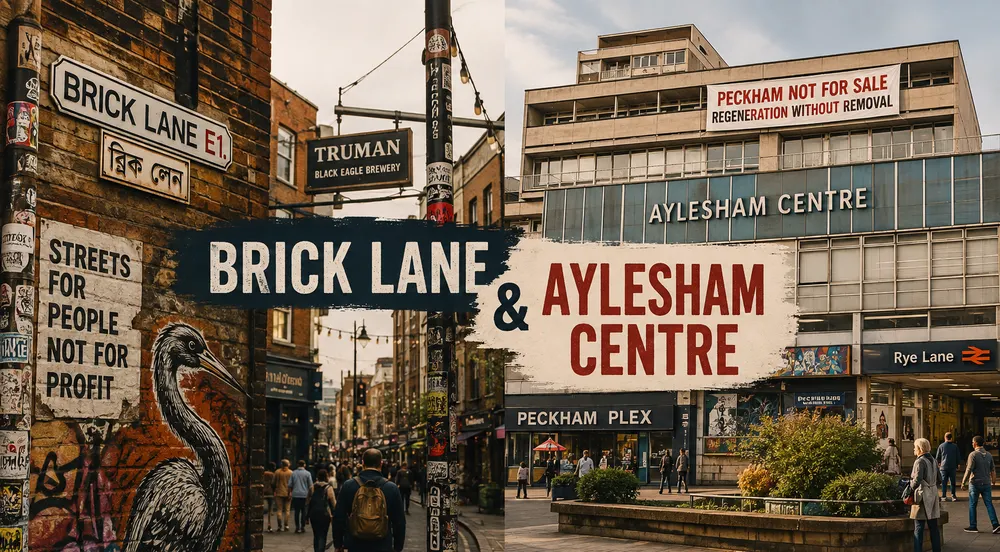
The struggle over the Aylesham Centre does not exist in isolation.
Across London, major redevelopment proposals are increasingly moving through a prolonged sequence of planning applications, appeals, inquiries, ministerial intervention and litigation. The battle over the Truman Brewery at Brick Lane provides an important comparison.
The circumstances are not identical, but the underlying questions are strikingly similar. Both concern valuable sites at the centre of established, culturally distinctive London communities. Both involve arguments that major development is necessary to secure investment and economic growth.
Both have raised fundamental questions about affordable housing, displacement, heritage, land value and who ultimately benefits from regeneration.
And in both cases, decisions made through the local planning process have proved to be only one stage in a much longer struggle.
The Brick Lane Experience
The legal and planning history of the Truman Brewery demonstrates why the dismissal of the Aylesham appeal cannot yet be regarded as the end of the matter.
An earlier Truman Brewery development approved by Tower Hamlets in 2021 was challenged by the Spitalfields Historic Building Trust through judicial review.
That challenge travelled through the High Court and Court of Appeal before reaching the Supreme Court. On 26 March 2025, the Supreme Court unanimously dismissed the appeal, leaving the original planning permission intact.
The dispute over Brick Lane nevertheless continued.
In 2024, the Truman Brewery owners brought forward a much larger series of proposals covering sites across and around the brewery. Tower Hamlets Council subsequently refused those proposals. The developers appealed.
Following a public inquiry, the Secretary of State recovered the appeals for ministerial determination.
Then, on 29 July 2026, all four appeals were allowed, granting permission for the Grey Eagle Street data centre, the principal Truman Brewery redevelopment, the Ely's Yard commercial development and listed-building works at the Boiler House.
The result was that a development opposed by the local authority and a substantial community campaign ultimately secured permission through the national planning system.
Two Cases — Opposite Directions
There is an important difference between Brick Lane and Aylesham.
At Brick Lane, community and heritage campaigners used judicial review to challenge a planning approval.
At Aylesham, the developer is using judicial review to challenge a planning refusal.
That distinction should not be overlooked.
Judicial review exists to test whether public decisions have been made lawfully. It does not determine whether a development is socially desirable, whether enough affordable housing has been provided or whether a community has received a fair share of the value created by redevelopment.
But the comparison illustrates something much broader.
A local planning decision is not necessarily the end of the planning struggle.
At Aylesham, Southwark Council and community campaigners successfully opposed a scheme of 867 homes containing only 77 affordable homes, and the Planning Inspector dismissed Berkeley's appeal.
Berkeley has now gone to the High Court seeking to overturn that decision.
At Brick Lane, Tower Hamlets unanimously rejected the later Truman Brewery proposals, yet the developer's appeals were subsequently recovered and allowed by central government.
The two cases therefore reveal different routes through which contested development can continue after apparently decisive local or planning victories.
Planning Power and the Right to Remain
The comparison also exposes a deeper imbalance within the development system.
Major landowners and developers possess the resources to continue pursuing consent through planning appeals, revised applications and litigation.
Communities faced with those proposals must repeatedly raise funds, obtain expert evidence, engage lawyers, organise public campaigns and maintain participation over periods that can extend for years.
Brick Lane demonstrates how prolonged that process can become.
Aylesham may now be entering another stage of the same wider struggle over who has the power to determine the future of London's neighbourhoods.
The lesson should not be that communities should abandon opposition because developers can appeal or litigate.
It is the opposite.
The decisions at both Aylesham and Brick Lane demonstrate why sustained public scrutiny is necessary throughout the entire process.
Beyond Aylesham and Brick Lane
Taken together, the two campaigns point towards a broader question for London planning.
If regeneration repeatedly produces developments containing housing beyond the reach of much of the existing population, commercial premises that existing traders may struggle to afford, and increases in land value that principally accrue to private landowners, then simply describing that process as regeneration tells us very little.
We must ask:
Who owns the land?
Who captures the increase in land value created through planning permission?
Who can afford the housing produced?
Which businesses can afford to return?
Who bears the disruption and displacement?
And who ultimately has the power to decide?
These questions connect Peckham with Brick Lane and with development disputes taking place across London.
They are also why the principle at the heart of this campaign remains important:
Regeneration without removal.
Development should improve places for the communities already living and working there, rather than treating their displacement as an acceptable consequence of increasing land values.
Campaign and Further Information
Aylesham Centre — Peckham
ConserveConnect — Aylesham Centre, Peckham: Regeneration Without Removal (Right to Remain)
Campaign background, objectives and continuing updates.
https://conserveconnect.com/campaigns/aylesham-centre-peckham-regeneration-without-removal-right-to-remain
Aylesham Community Action
The principal community campaign for an Aylesham redevelopment that meets the needs of Peckham.
https://www.ayleshamcommunityaction.co.uk/
Planning Inspectorate — Aylesham Centre Appeal
Official appeal record: APP/A5840/W/25/3366760.
https://acp.planninginspectorate.gov.uk/ViewCase.aspx?Caseid=3366760&CoID=0
Planning Inspectorate — Appeal Decision, 18 May 2026
The Inspector's decision dismissing Berkeley Homes' appeal and refusing planning permission.
https://acp.planninginspectorate.gov.uk/ViewDocument.aspx?fileid=65589336
Southwark Council — Aylesham Centre Plans Are Dismissed
Council statement following the Planning Inspector's decision.
https://www.southwark.gov.uk/news/2026/aylesham-centre-plans-are-dismissed-statement-southwark-council
Southwark Council — Council Joins Judicial Review
4 August 2026 statement confirming that Southwark has joined the Berkeley Homes judicial review as an interested party.
https://www.southwark.gov.uk/news/2026/southwark-council-joins-judicial-review-stand-residents-aylesham-appeal
Peckham Not For Sale — CrowdJustice
Aylesham Community Action's campaign and legal fundraising page.
https://www.crowdjustice.com/case/acapeckham/
Peckham Vision — Aylesham/Morrison Site
Detailed community record of the site's development and planning history.
https://www.peckhamvision.org/wiki/Aylesham/Morrison_site
The Wider London Context — Brick Lane
ConserveConnect — Save Brick Lane
Our campaign page supporting the protection of Brick Lane's cultural, social and architectural character.
https://conserveconnect.com/campaigns/save-brick-lane
Save Brick Lane
Community campaign information, planning history and updates.
https://sites.google.com/view/savebricklane
UK Supreme Court — Spitalfields Historic Building Trust v London Borough of Tower Hamlets
The judicial-review litigation concerning the earlier Truman Brewery planning permission, culminating in the Supreme Court judgment of 26 March 2025.
https://www.supremecourt.uk/cases/uksc-2023-0121
UK Government — Truman Brewery Recovered Appeals, 29 July 2026
Secretary of State's decision letter and Planning Inspector's Report covering the four later Truman Brewery appeals.
https://www.gov.uk/government/publications/recovered-appeal-sites-on-and-around-the-site-of-truman-brewery-tower-hamlets-london-refs-3367041-3367172-3367179-and-3367369-29-july-2026
ConserveConnect News — Truman Brewery Legal Challenge: The Public Case for Reviewing the Brick Lane Ruling
Our analysis of the July 2026 decision and the potential basis for further legal scrutiny.
https://conserveconnect.news/truman-brewery-ruling-an-open-basis-for-review/