
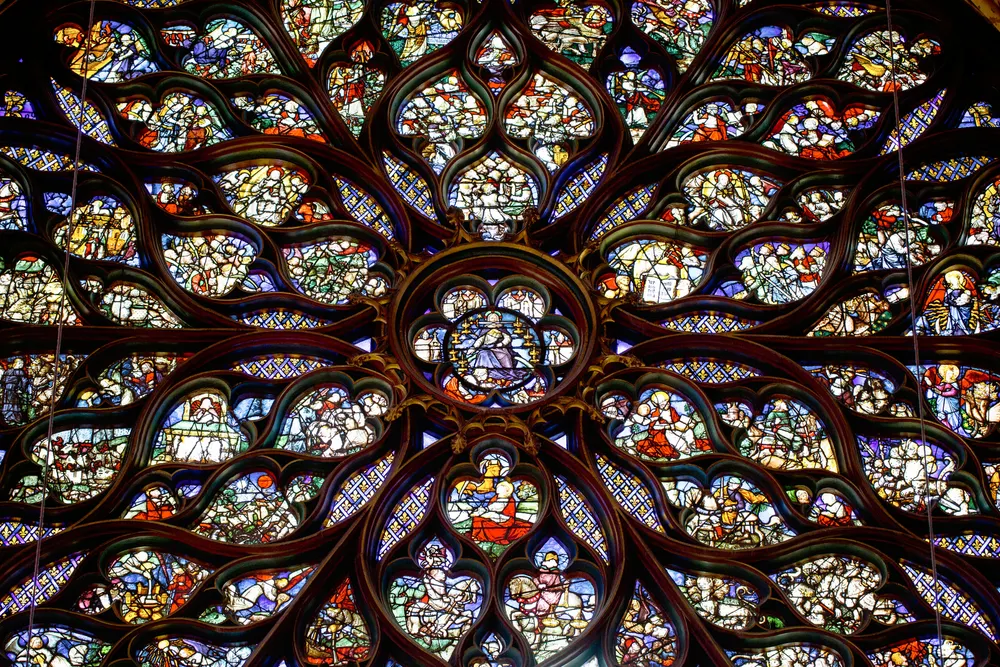
The revival of stained glass conservation is not simply about admiring colour and light. It is a renewed understanding that historic windows are art, structure, weathering fabric, memory and vulnerable material evidence and that they need specialist care, restraint and informed repair.
Stained glass is often the first thing people notice in a historic church, chapel or public building, and the last thing they fully understand.
From a distance it appears almost immaterial: colour suspended in light, saints and symbols glowing above stone, stories told through blue, ruby, gold and white. Yet stained glass is not weightless. It is made of sand, flux, metal oxides, paint, silver stain, lead, solder, putty, iron, bronze, stone and air. It is both image and structure. It is artwork and weathering fabric. It is devotional object, public memorial, architectural surface and environmental system.
This is why the conservation of stained glass matters. A window cannot be cared for properly if it is treated only as decoration. It must be understood as part of the building itself: exposed to rain and wind from outside, condensation and heating from within, movement in the masonry, corrosion in metal supports, decay in painted surfaces and the slow fatigue of leadwork. The beauty of stained glass depends on a hidden assembly of materials and craft.
Like traditional plastering, stained glass conservation now requires a change in thinking. For too long, repair culture often meant replacement: broken glass was discarded, leadwork was routinely renewed, panels were rearranged, surfaces were over-cleaned, and later interventions were removed without sufficient understanding. Today, the best stained glass conservation begins not with replacement or cosmetic repair, but with careful investigation. What is original? What is later but significant? What has already been lost? What is unstable? What should be left alone? What should be recorded? What kind of protection will allow the glass to survive without falsifying its appearance?
The revival of stained glass conservation is therefore not a matter of nostalgia. It is a recovery of judgement.
More Than Coloured Light
The popular language of stained glass tends to emphasise beauty: the glow, the jewel colours, the figures, the stories, the atmosphere. All of that matters. Stained glass is one of the great arts of historic buildings precisely because it transforms daylight into meaning.
But stained glass is also physical fabric. It keeps weather out. It admits light. It moves with heat and cold. It depends on lead, ties, bars, grooves, putty, stone, ironwork and maintenance. It belongs to the architecture, not merely to the interior decoration.
A medieval window, a Victorian memorial light, an Arts and Crafts scheme or a 20th-century university chapel window cannot be understood only as an image. It must be read as a made object and as part of a building. The glass may be mouth-blown, crown, cylinder, flashed, painted, stained, etched, plated, cast or opalescent. The lead lines may be part of the drawing. The paint may be fragile. The ferramenta may be medieval. The stone grooves may have been altered. The protective grille may be doing harm as well as offering security.
To care for stained glass properly, one must look beyond the picture.
Fragile Permanence
Glass seems permanent because it is hard, dense and ancient examples survive. Yet historic glass can be surprisingly vulnerable. Its durability depends on its composition, the quality of manufacture, the firing of paint, the stability of the leadwork and, above all, the environment in which it sits.
Moisture is often the central problem. Rain can attack the exterior face. Condensation can repeatedly wet the interior face. Where water remains on glass, especially chemically unstable glass, it can trigger pitting, crusting, leaching, paint loss and microbiological growth. Medieval potash glass may be particularly vulnerable, but later glass can also suffer. Some 19th-century painted glass, especially where paint was under-fired or chemically unstable, can lose detail through repeated wetting.
This creates one of the paradoxes of stained glass conservation. A window may look radiant from the nave while, close up, its surface is pitted, crusted, flaking, scratched or losing its painted detail. Transmitted light can disguise decay. Distance can make fragility look like survival.
The modern revival of stained glass conservation begins by taking this fragility seriously.
The Old Error: Replacement Culture
Historic stained glass has often suffered from well-intentioned repair. Earlier generations commonly treated stained glass more as a window to be kept serviceable than as a complex historic artefact. Broken pieces could be replaced. Missing areas could be made good. Panels could be reordered. Heavy new leads could be introduced. Stopgaps could be discarded. Dirty glass could be scrubbed. Earlier repairs could be swept away in pursuit of a cleaner or more unified appearance.
Some interventions saved windows from collapse. Others destroyed evidence.
This is why conservation is not the same as restoration. Restoration often asks how a thing might be made to look whole again. Conservation asks what survives, what it means, what is vulnerable, and how much intervention is truly necessary.
The shift is profound. A cracked piece of glass is not automatically a candidate for replacement. A distorted panel is not automatically a case for wholesale releading. A dirty surface is not automatically something to clean. A later repair is not automatically intrusive. Old lead is not automatically expendable. A window may contain medieval glass, post-Reformation rearrangement, Victorian intervention, war damage, 20th-century repair and modern conservation — all layered into one historical object.
The task is not to erase this history, but to understand it.
Lead Is Not Merely a Support
Leadwork is often treated as a technical background to the more important glass. That is a mistake. In stained glass, the lead matrix is structure, drawing, repair history and evidence.
Lead lines hold the window together, but they also shape the image. In medieval and Arts and Crafts windows especially, the lead is not simply a net into which coloured pieces are fitted. It is part of the design. It gives rhythm, emphasis, shadow and structure. Releading a window can therefore be a major intervention, even where the glass itself is retained.
There is a persistent assumption that leadwork has a predictable life and should be renewed after a fixed period. This is too crude. Some lead deteriorates quickly because of poor alloy, stress, weathering, heat, movement or bad installation. Other lead can survive for centuries. The right question is not “How old is it?” but “What is its condition, significance and function?”
A conservation-led approach does not refuse releading where it is necessary. It refuses unnecessary releading where it would destroy evidence, alter the drawing or impose a modern regularity on historic work.
Cleaning as an Act of Restraint
Few conservation decisions reveal the difference between care and improvement more clearly than cleaning.
Stained glass and leaded windows do not normally require regular cleaning. Dirt, limescale, soot, rust staining, biological growth and accretions may obscure the image, but cleaning is not housekeeping. It is an intervention into fragile material.
The risks are real. Glass can scratch. Paint can flake. Medieval corrosion crusts may conceal a dangerously fragile surface beneath. Abrasive pads, wire wool, household cleaners, acids, rough rubbing and even apparently harmless dusting can cause permanent damage. Once painted detail has been removed, it is extremely difficult — and often impossible — to recover honestly.
This does not mean windows should never be cleaned. Cleaning can reveal a neglected window, restore legibility, reduce harmful deposits and improve understanding. But it should be done only after proper assessment. Sometimes the safest method may be the gentlest rolling of deionised water on cotton. Sometimes microscopic studio work may be required. Sometimes deposits should remain.
The conservation ethic is simple: if in doubt, do less.
Modern Materials, Old Ethics
A revival of stained glass conservation does not mean rejecting modern materials. It means using them intelligently.
Adhesives are a good example. In the past, cracked glass was often repaired by inserting additional lead. This could preserve the original piece, but it also introduced new lead lines into the image and sometimes required trimming the broken edges. Modern techniques such as epoxy edge-gluing, silicone edge-gluing and copper foil repair offer other possibilities.
Each has advantages and risks. Epoxy can produce an almost invisible repair and may be valuable where a crack crosses a face or important detail, but it is relatively difficult to reverse and may need protection from ultraviolet light. Silicone can provide flexibility and greater reversibility, especially useful in multi-layered or opalescent glass. Copper foil can be strong, visually discreet and reversible where cracks are limited. None is universally right.
The important point is that modern materials should serve conservation principles: retaining original fabric, minimising visual disruption, maintaining reversibility where possible, and avoiding treatments that future conservators cannot understand or undo.
The best modern stained glass conservation is not anti-modern. It is anti-careless.
Protective Glazing: Protection With Consequences
Environmental protective glazing has become one of the most important tools in stained glass conservation. Properly designed, it can reduce condensation, protect fragile glass from rain and wind, reduce environmental deterioration, and allow vulnerable windows to remain in situ. For some important or unstable glass, it may be the single most important intervention available.
But protective glazing is not a neutral addition. It changes the building. It may alter the exterior appearance of the window. It may require movement of the historic glass. It may affect stonework, metalwork, ventilation and maintenance access. Poorly designed systems can create reflections, parallax, visual confusion, interstitial condensation or a flat external surface that weakens the relationship between glass and architecture.
This is why protective glazing must be treated as a conservation design problem, not a product choice. The question is not simply whether a second layer of glass can be fitted. It is how the whole window will perform and appear: from inside, from outside, in rain, in sunlight, in winter, in relation to stone, lead, ironwork, ventilation and long-term maintenance.
The most successful systems are those that protect the stained glass without making the building pay too high a visual or physical price.
The Environment Is Part of the Window
A stained glass window is never alone. It belongs to a microclimate.
A damp church, intermittent heating, cold north-facing windows, poor ventilation, leaking gutters, failed masonry, wet floors, flowers, large congregations, blocked drainage or protective grilles can all affect the condition of the glass. A window may be damaged not because the glass is poorly made, but because the building environment repeatedly wets it.
This matters because repair alone may not solve the problem. A conserved window placed back into the same damaging environment may begin to deteriorate again. Conversely, improving rainwater disposal, ventilation, heating patterns, access and monitoring may reduce the need for more invasive intervention.
The future of stained glass conservation therefore lies partly in better building care. Gutters, roofs, stonework, heating, ventilation, access and maintenance are all stained glass issues.
The Glass Itself Matters
The revival of stained glass care should also remind us that historic glass is not merely a carrier of painted images. The glass itself has significance.
Mouth-blown cylinder glass, crown glass, cast glass, flashed glass, opalescent glass and early plain window glass all carry evidence of manufacture. Bubbles, streaks, distortions, colour variation, thickness, ripples and pane size tell us about technology, cost, trade and period. Even plain historic window glass can be part of the story of a building.
Modern perfectly flat glass is not a neutral substitute. It can change the light, the reflections, the character of the elevation and the atmosphere of the interior. This is particularly important where historic plain glazing survives in leaded lights, domestic windows, meeting houses, churches, or as part of protective glazing design.
To replace old glass casually is to lose more than material. It is to lose the particular way a building admits light.
Windows as Witnesses
Stained glass has survived through conflict, reform, neglect, fashion, weather, accident and changing taste.
The history of English stained glass is not a simple story of continuous preservation. It includes Reformation iconoclasm, Civil War damage, the removal and concealment of imagery, antiquarian collecting, Georgian rearrangement, Victorian restoration, wartime loss, post-war repair and modern conservation. Many medieval windows are now composites: fragments, stopgaps, rearranged panels, later insertions, missing heads, reinterpreted subjects and repairs made across centuries.
This does not make them less important. It makes them more historically charged.
A stained glass window can be a survivor of religious upheaval, a record of patronage, a witness to local devotion, a work of national art, a memorial to war, or a fragment of a lost decorative world. Its cracks, replacements and repairs may be part of that meaning.
The modern conservation task is not to return every window to an imagined original state. It is to preserve what survives, understand what has happened, and allow the window to continue speaking.
The Modern Revival of Artistic Seriousness
The revival of stained glass is not only medieval. One of the most important shifts in recent decades has been the growing recognition of 19th- and 20th-century stained glass as heritage in its own right.
Victorian glass was long dismissed as formulaic or over-produced. Some of it was. But the period also saw extraordinary experimentation, technical recovery and artistic ambition. Artists such as David Evans helped move stained glass from painterly panels towards a renewed Gothic and medievalising language. Later, the Arts and Crafts movement challenged the division between designer and maker, insisting that stained glass should be understood as a complete art of drawing, cutting, painting, firing, leading and architectural integration.
Christopher Whall and those influenced by him helped restore the idea of the stained glass artist as a craftsperson engaged with the whole process. Karl Parsons, Douglas Strachan, Wilhelmina Geddes, Harry Clarke, Evie Hone, Trena Cox and many others made windows of remarkable force, individuality and seriousness. Their work belongs not at the margins of conservation, but at its centre.
War memorial stained glass adds another dimension. These windows are not only artistic objects; they are acts of mourning, local memory and public witness. They record names, grief, sacrifice, faith, community and the aftermath of conflict. To neglect them because they are “only” 20th-century is to misunderstand their significance.
The modern revival of stained glass care must therefore include the regional, the Victorian, the Arts and Crafts, the memorial, the modern and the overlooked.
The Hidden Structure of Light
Much of what matters in stained glass is hidden or easily ignored.
Behind the glow are lead cames, solder joints, cement, ties, saddle bars, ferramenta, glazing grooves, ferramenta lugs, putty, bronze supports, stone tracery, protective grilles, drainage channels and ventilation paths. Corrosion in an iron support can crack stone. Failed ties can allow panels to bow. Poorly maintained grilles can trap moisture or cast damaging shadows across the image. Bad repairs can create stress points. Over-heavy leads can darken a composition. Inaccessible windows may deteriorate simply because no one can inspect them.
A stained glass window is therefore not only conserved by a stained glass specialist. It may also require the knowledge of architects, surveyors, stone conservators, metal conservators, environmental specialists, historians and building custodians.
This is why skilled care matters. Stained glass is a collaboration of materials, and its conservation often requires a collaboration of disciplines.
What the Revival Requires
The revival of stained glass conservation will not be secured by admiration alone.
It requires building owners and church custodians who understand that historic windows need periodic inspection, not emergency attention only when panels bulge, leak or fail.
It requires proper records: photographs, rubbings, condition reports, repair histories, archival research and documentation of decisions. Future conservators should not have to guess what was done.
It requires caution around cleaning, releading and replacement. The cleanest window is not always the best conserved window. The newest lead is not always the safest answer. A visually perfect repair may conceal loss of evidence.
It requires environmental understanding. Heating regimes, condensation, humidity, drainage, orientation and maintenance must be treated as part of stained glass care.
It requires careful judgement about protective glazing. EPG can be transformative, but it must be justified, designed and maintained in relation to the whole building.
It requires recognition of overlooked artists, regional makers, women artists, 20th-century windows and memorial glass.
Above all, it requires specialist skill. Stained glass conservation is not general glazing. It is the care of fragile historic fabric in which art, chemistry, craft, architecture and memory meet.
Conserving Light
The wisdom of stained glass conservation lies in recognising that a window is never only a window.
It is light shaped by material. It is image held in structure. It is memory exposed to weather. It is fragile permanence.
The old mistake was to treat damage as a problem to be made invisible and age as something to be overcome. The better approach is slower and more careful. It asks what the glass is, how it was made, how it has survived, what threatens it now, and what kind of intervention will allow it to remain both legible and true.
The future of stained glass conservation is not about making historic windows appear new. It is about enabling them to endure — as works of art, as building fabric, as historical evidence and as living expressions of light.
Finding the Right Stained Glass Specialist
Historic stained glass is not one field but a family of related skills: stained glass conservation, leaded light repair, glass painting, protective glazing, historic metalwork, stone surrounds, environmental assessment, documentation and church repair.
ConserveConnect lists practitioners and companies working in these fields, helping building owners, churches, architects, surveyors and conservation professionals find suitable expertise for sensitive repair.
Selected Voices in Stained Glass Conservation and History
The revival of stained glass conservation has been shaped by a wide field of artists, conservators, historians, scientists, architects and specialist craftspeople. The following names are not an exhaustive canon, but they represent important strands of current knowledge.
Sarah Brown
Important on medieval stained glass, York Minster, iconoclasm, restoration history and conservation scholarship.
Drew Anderson
Important on glass chemistry, decay, moisture, corrosion and conservation principles.
Tobit Curteis and Naomi Luxford
Important on protective glazing, environmental buffering and research-led conservation.
Robyn Pender
Important on environmental protective glazing, building physics and the decision-making framework for intervention.
Léonie Seliger
Important on stained glass cleaning, microbial growth, paint fragility and practical conservation ethics.
Sebastian Strobl
Important on historic leadwork, minimum intervention and the significance of lead as part of the historic window.
Mark Bambrough
Important on the aesthetics of protective glazing and the relationship between stained glass, architecture and exterior appearance.
Dan Humphries
Important on stained glass and its environment, especially condensation, paint loss and practical decisions around EPG.
Brian Hall
Important on historic metalwork associated with stained glass, including ferramenta and early iron support systems.
Nicola Gordon Bowe
Important on An Túr Gloine, Irish stained glass and the Arts and Crafts revival.
Jonathan Taylor
Important on Arts and Crafts stained glass, Karl Parsons, war memorial windows and the recognition of stained glass as public heritage.
Peter Jones
Important on regional stained glass artists, particularly Trena Cox and the inter-war period.
Michael Brückner
Important on historic window glass, mouth-blown glass, crown glass, cylinder glass and the material history of glazing.
Selected Further Reading
The following texts and publications have helped shape modern understanding of stained glass, protective glazing, decay, cleaning, historic glass and stained glass artists. They are included as a reference shelf for readers wishing to explore the subject further.
Drew Anderson, Stained Glass and Its Decay
Tobit Curteis and Naomi Luxford, Protective Glazing
Robyn Pender, Protective Glazing: Deciding Whether or Not to Use EPG
Dan Humphries, Stained Glass and its Environment
Léonie Seliger, Cleaning Historic Stained Glass Windows
Roberto Rosa, Adhering to the Point: The Use of Adhesives in Stained Glass Restoration
Mark Bambrough, Aesthetic Protective Glazing
Sarah Brown, Reformation, Iconoclasm and Restoration: Stained Glass in England c1540–1830
Andrew Arrol and Sarah Brown, The Great East Window of York Minster
Brian Hall, The South Oculus, Canterbury Cathedral
Michael Brückner, Historic Window Glass
Lorna Roberts, David Evans: The Forgotten Pioneer
Nick Haynes, A Spiritual Enterprise: Douglas Strachan’s Stained Glass in the Memorial Chapel, University of Glasgow
Nicola Gordon Bowe, The Tower of Glass: An Túr Gloine and the Early 20th Century Stained Glass Revival in Ireland
Peter Jones, Trena Cox: Emergence of a Stained Glass Artist
Jonathan Taylor, Karl Parsons and the Rise of Arts & Crafts Stained Glass
Classic and Technical References
Corpus Vitrearum, Guidelines for the Conservation and Restoration of Stained Glass
Christopher Whall, Stained Glass Work
Richard Marks, Stained Glass in England During the Middle Ages
Michael Archer, English Stained Glass
Peter Cormack, Arts & Crafts Stained Glass
Historic England, Stained Glass Windows: Managing Environmental Deterioration
Historic England, Conserving Stained Glass Using Environmental Protective Glazing
English Heritage, Glass & Glazing: Practical Building Conservation