Open Letter to Lambeth Council: Refuse the Demolition and Redevelopment of the Railway Bell, Gipsy Hill

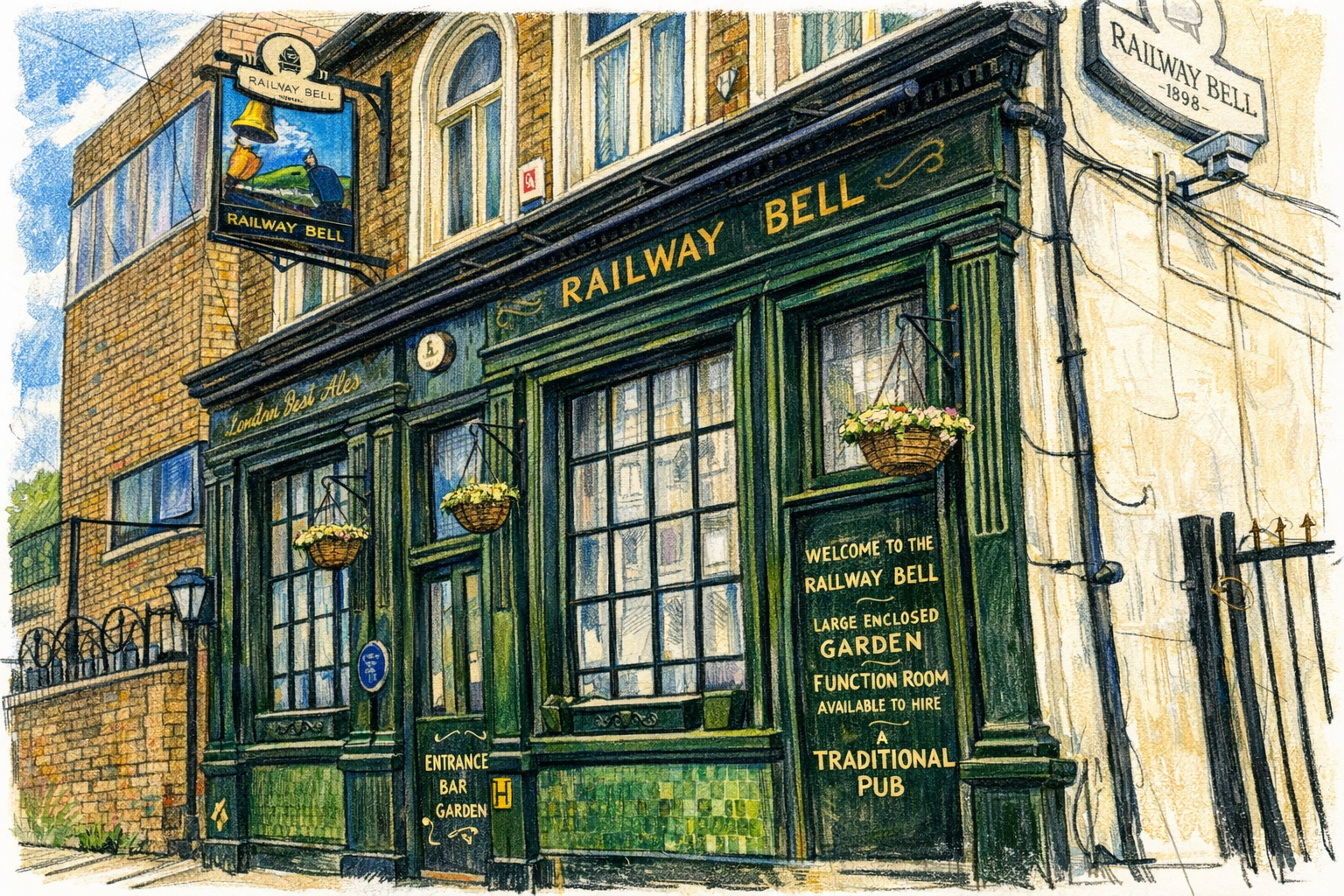
This open letter is being published because opposition to the proposed demolition and redevelopment of the Railway Bell is plainly broader than the number of formal objections likely to appear on the planning file. It sets out why Lambeth Council should refuse application 26/00528/FUL and urges all supporters to follow their signature with a formal objection.
The proposed demolition and redevelopment of the Railway Bell in Gipsy Hill has generated clear and growing public concern. Yet public concern, however widely felt, does not always appear in the planning file with equal force. Formal objections take time to prepare. They require confidence, clarity and, often, familiarity with planning language that many residents and supporters do not have.
That is one reason for publishing this open letter.
The other is that the proposal now before Lambeth Council is not a minor alteration to a building of limited consequence. It concerns a locally listed public house, long embedded in the historic and social fabric of Gipsy Hill, and a scheme that would retain only the frontage while demolishing the substantive pub structure and outbuildings behind it in order to create nine one bedroom flats. What is at issue, therefore, is not merely design but principle: whether the reduction of a valued local building to its street face should be accepted as meaningful conservation, and whether the extinguishment of a long standing communal use should be treated as an acceptable price for a modest residential yield.
This open letter is intended to make visible the breadth of opposition to that proposition. It is published to support the campaign against the scheme, to articulate the planning and heritage concerns more fully, and to encourage all those who sign it to go on and register their objections formally with Lambeth Council.
Open Letter to Lambeth Council
To Lambeth Council Planning Department
Re: Planning Application 26/00528/FUL
Site: Railway Bell, 14 Cawnpore Street, London SE19 1PF
Dear Sir or Madam,
We write as residents, local supporters, heritage advocates, and members of the wider public to object in the strongest possible terms to planning application 26/00528/FUL concerning the Railway Bell, 14 Cawnpore Street, Gipsy Hill.
The proposal is for the construction of nine one bedroom apartments, together with associated amenity space, cycle storage and bin storage, while retaining only the frontage of the existing pub and demolishing the principal structure and outbuildings behind it.
We submit that this application should be refused.
The proposal would cause serious and unjustified harm to a locally listed heritage asset, would result in the loss of a building of clear community and townscape significance, would fail to demonstrate a convincing case for the permanent loss of the pub use, and would substitute a highly limited residential gain for the destruction of a locally meaningful social building. Above all, it asks the Council to accept the appearance of preservation in place of preservation itself.
That should not be accepted.
The Railway Bell is not an incidental structure whose significance lies only in the visual contribution of its street frontage. It is a historic public house, part of the inherited social and architectural fabric of Gipsy Hill, and a building whose meaning rests in the relationship between its material form, its long established use, and its place in the neighbourhood’s collective life. A building of this kind does not derive its significance merely from what can be seen in elevation. Its significance lies also in its survival as a whole building, in its continuity of use, and in the fact that it has served as a recognisable place of public gathering and local memory.
For that reason, the retention of the frontage cannot reasonably be treated as an adequate answer to the loss proposed here. A historic public house is not meaningfully conserved where the principal structure behind the street face is demolished. To retain the exterior shell or front elevation while removing the body of the building is not conservation in the proper sense. It is facadism: the preservation of a surface image while the historic building itself is effectively destroyed. Such an approach empties heritage of substance and reduces conservation to a visual gesture.
The Council should be particularly cautious where a proposal depends so heavily on this visual sleight of hand. The question is not whether something remains visible from the street. The question is whether what remains can honestly be said to preserve the significance of the asset. Here, plainly, it cannot. The proposal preserves a face while removing the building’s physical depth, functional integrity, and social meaning. It leaves behind a remnant and asks that remnant to bear the interpretive burden of the whole. That is too slender a basis upon which to justify the demolition of a locally listed building.
The proposal is also objectionable because it would result in the loss of a valuable community asset. A public house is not merely a commercial premises like any other. Public houses have historically served as places of assembly, social contact, recognition, informal exchange, neighbourhood cohesion and collective memory. Even where trading conditions have become difficult, the planning system ought not to treat their disappearance as neutral or inevitable. Buildings of this kind perform a civic function that is not replicated simply by providing private residential accommodation on the same site.
That point is especially important in areas subject to intense development pressure. Where local gathering places are steadily eroded, communities lose not only buildings but the settings in which ordinary civic life occurs. A planning authority should therefore require a strong and convincing case before sanctioning the permanent loss of such a building and use. It should not proceed on the assumption that once a pub has become commercially vulnerable, its removal becomes a matter of routine.
No such convincing case has been demonstrated here.
There are serious concerns as to whether the application has adequately justified the extinguishment of the pub use. Public reporting on the scheme indicates that the marketing case relied upon was around fourteen months, and objectors have questioned whether this is sufficient to justify the permanent loss of a long standing public house and meeting place. Even leaving aside the precise policy arguments that may arise, the broader principle is obvious: where the proposed loss is irreversible, the evidential burden should be substantial. It should require a robust demonstration that continued pub use, hospitality use, mixed use, community use, or another socially beneficial local use is genuinely unviable. A thin or hurried exercise should not suffice.
Nor should the Council overlook the possibility that buildings of this kind may have value beyond the narrow use class in which they have most recently operated. The question is not simply whether the existing business model succeeded in its most recent form. The question is whether the building itself retains potential for continued public, hospitality, cultural, or community use if approached differently. To move too quickly from commercial difficulty to demolition is to confuse present weakness with permanent impossibility.
The application also fails the test of proportionality.
The public benefit offered in exchange for the harm is extremely limited. The scheme proposes nine one bedroom flats. That is not an insignificant number in the abstract, but it is plainly a modest yield in the context of the permanent loss proposed here. The Council is being asked to accept the effective destruction of a locally listed public house and the extinguishment of its communal function in return for a small residential scheme of highly restricted social range. This is not a case in which overwhelming public gain is offered to justify serious heritage and community harm. The benefit is narrow. The harm is lasting.
The issue is not opposition to housing as such. It is whether every building of local meaning is now to be treated as a development opportunity whose highest and best use is assumed to lie in subdivision, extraction and disposal. Planning should be capable of more serious discrimination than that. It should recognise that some buildings matter because they sustain the social texture of a place, and that once they are reduced to their facade and absorbed into a private residential scheme, something irrecoverable has been lost.
This is why the proposal raises a matter of wider principle.
If this form of redevelopment is accepted here, it sends the message that a locally significant public house may be hollowed out, stripped of its substantive structure, and re-presented as conserved so long as its frontage survives. It tells communities that the image of continuity is enough, even where continuity in any real social or material sense has been broken. It invites a planning culture in which the survival of a wall is taken to answer the loss of a building, and the retention of a facade becomes a routine mechanism for licensing demolition under a conservation vocabulary.
That is not a precedent Lambeth Council should set.
The Council should instead affirm a clearer principle: that the conservation of a locally listed building means more than visual tokenism; that community assets deserve serious protection; that the permanent loss of a public house requires a rigorous and transparent evidential basis; and that modest residential gain does not automatically outweigh serious heritage and community harm.
For all of these reasons, we respectfully urge Lambeth Council to refuse planning application 26/00528/FUL.
The Railway Bell should not be reduced to a decorative remnant of itself. A planning system that preserves only the face of a public house while demolishing its body and extinguishing its civic life is not conserving heritage. It is administering loss.
Yours faithfully,
The Undersigned
Add your name to the open letter, then lodge your objection formally with Lambeth Council. Signing this letter helps make wider opposition visible, but it is not a substitute for submitting an official planning objection.
If you have signed this letter, please now lodge your objection formally
Signing this open letter helps demonstrate the breadth of public opposition, but it does not itself count as a formal planning objection.
Anyone who signs, and anyone who supports this campaign, should also submit their objection directly to Lambeth Council through the planning applications database by searching for application 26/00528/FUL, opening the application record, and using the “Make a comment” function. Lambeth states that online comments require a registered account and that anonymous comments are not accepted.
Official objection link:
Lambeth planning applications: search and comment on applicationshttps://www.lambeth.gov.uk/planning-building-control/planning-applications/search-submit-comment-applications
Application reference:
26/00528/FUL
Suggested objection texts for readers to adapt
Below is a strong model objection people can adapt and submit to Lambeth Council for 26/00528/FUL. I have included a fuller version, a tighter portal version, and a very short version for people who want something concise.
Long version objection
Objection to Planning Application 26/00528/FUL
Railway Bell, 14 Cawnpore Street, London SE19 1PF
Dear Sir or Madam,
I object to planning application 26/00528/FUL at the Railway Bell, 14 Cawnpore Street, SE19 1PF.
The application proposes the construction of nine one bedroom apartments, together with associated private and communal amenity space, bin and bike storage, while retaining only the existing Railway Bell pub frontage and demolishing the existing pub structure and outbuildings behind it. Public listings describe the scheme in those terms, and the application is shown as awaiting decision.
My objection is made on the following grounds.
First, the proposal would cause serious and unjustified harm to a locally listed heritage asset. Public reporting identifies the Railway Bell as being on Lambeth Council’s Local Heritage List, notes that there has been a pub on the site since around 1865, and states that the present building dates from 1892. The significance of such a building lies not only in its street frontage but in its survival as a whole building, in its historic fabric, and in its long association with local social life. Retaining only the frontage while demolishing the substantive structure behind it is not meaningful conservation. It leaves only a visual remnant while destroying the building’s material and historic integrity.
Second, the proposal would result in the loss of a valued community asset. A public house is not simply a commercial unit. It forms part of the social infrastructure of the area: a place of gathering, contact and neighbourhood identity. The planning system should therefore require a strong and convincing case before accepting the permanent loss of such a building and use. That is especially so where the building also has recognised local heritage significance.
Third, there are serious concerns that the loss of the pub use has not been adequately justified. Public reporting on the application states that the marketing exercise relied upon lasted around 14 months, and objectors have raised concerns that this is insufficient to justify the permanent loss of a long established public house and meeting place. Before allowing the irreversible loss of this use, Lambeth Council should require robust evidence that continued pub, hospitality, community, or other locally beneficial use is genuinely unviable.
Fourth, the public benefit is too limited to outweigh the harm. The scheme is for only nine one bedroom flats. That modest residential yield does not provide a compelling justification for demolishing most of a locally significant pub building and extinguishing its communal function. Housing delivery is important, but it should not automatically override substantial heritage and community harm, particularly where the benefit is relatively limited.
Fifth, the proposal relies on facadism. Retaining the frontage while removing the body of the building risks treating the appearance of continuity as a substitute for genuine preservation. Lambeth Council should assess the proposal on the basis of what is actually being lost, not merely what remains visible from the street. A retained frontage is not an adequate substitute for the survival of the Railway Bell as a historic public house.
For all of these reasons, I respectfully urge Lambeth Council to refuse planning application 26/00528/FUL.
Yours faithfully,
[Name]
[Address]
[Postcode]
Medium version objection
I object to application 26/00528/FUL at the Railway Bell, 14 Cawnpore Street. The proposal is for nine one bedroom apartments while retaining only the pub frontage and demolishing the existing pub structure and outbuildings behind it.
This would cause unjustified harm to a locally listed heritage asset. Public reporting states that there has been a pub on the site since around 1865, that the present building dates from 1892, and that the Railway Bell is on Lambeth Council’s Local Heritage List. Retaining only the frontage is not meaningful conservation. It preserves only an image of the building while destroying its substance.
The proposal would also result in the loss of a valued community facility. There are also concerns that the case for the permanent loss of the pub use is inadequate, with public reporting stating that the marketing exercise relied upon lasted around 14 months. Lambeth Council should require a much more robust demonstration that continued pub, hospitality, community, or other beneficial local use is genuinely unviable before allowing irreversible loss.
The public benefit is too limited to outweigh the harm. Nine one bedroom flats do not provide a sufficient justification for demolishing most of a locally significant pub building and extinguishing its communal use. Lambeth Council should therefore refuse this application.
Short version objection
I object to 26/00528/FUL because it would demolish most of the Railway Bell while retaining only the frontage in order to create nine one bedroom flats. Public reporting identifies the Railway Bell as a locally listed historic pub, with a pub on the site since around 1865 and the present building dating from 1892. Retaining only the frontage is not meaningful conservation, and the loss of the pub use and community function has not been convincingly justified. The public benefit is too limited to outweigh the heritage and community harm. Lambeth Council should refuse this application.
Supporters are encouraged to adapt the model objection in their own words rather than submitting it unchanged. Even a short personal addition can make an objection more effective. This might include your connection to Gipsy Hill, your knowledge of the Railway Bell, your concern about the loss of a local pub and community space, or your view that retaining only the frontage does not amount to meaningful conservation. Personalised objections help show the depth and breadth of concern and are generally more persuasive than large numbers of identical responses.