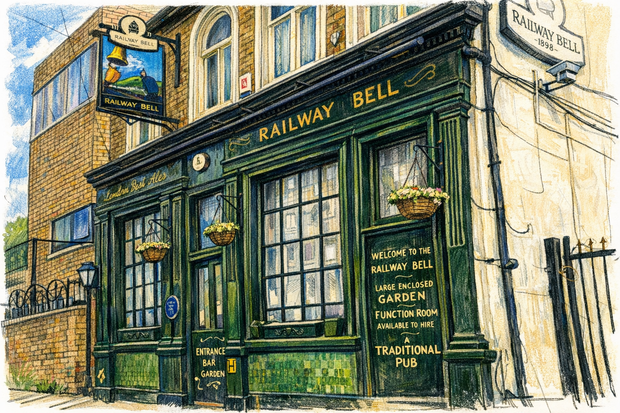
At 14 Cawnpore Street, beside Paxton School and opposite a play area, a small planning application has opened a much larger argument about what London now considers expendable. The proposal is for nine one-bedroom flats, with communal and private amenity, cycle and bin storage, and the retention of the Railway Bell’s pub frontage while demolishing the pub structure behind it. The site is not large. The application itself says it extends to about 496 square metres. The building is locally listed. The applicant’s own documents acknowledge that it is the only original building left along the street and that it retained a role as a local social hub.
This is how such matters are now usually introduced: a closed pub, a constrained site, a measured housing response, a careful nod to heritage, a promise of contextual design. The language is familiar and practiced. It belongs to a planning culture that has learnt how to speak of loss in the grammar of improvement. But the task of criticism is to put private proposals back into their public setting, to connect the small file on the planning portal to the larger habits of power and valuation that shape the city. In that wider frame, the Railway Bell proposal is not an isolated local dispute. It is one more instance of a metropolitan habit: reduce a socially legible building to its image, declare its former use unviable, intensify the site behind the retained face, and call the result regeneration.
The facts themselves are not hidden. The Design & Access Statement is explicit. It says the frontage of the pub is to be retained entirely, while the rest of the scheme is reorganised through a new mansard roof, a new side building and a new rear block around a courtyard. The drawings make the proposition plain. The Cawnpore Street elevation preserves the public front of the building while pushing a terracotta-clad roof form above it and new volumes beside and behind it. The courtyard elevation reveals the real mass of the scheme: not the old pub carefully adapted, but a denser residential composition occupying the depth of the plot.
So one must begin with a distinction that planning discourse often tries to blur. To retain a façade is not the same thing as to conserve a building. The Railway Bell is not being preserved as a working whole. Its public face is being held in place while the structure and use behind it are largely sacrificed. What survives is the frontage as credential. The building remains, but mainly as evidence that it once stood there.
That is why the specialist heritage objection matters so much. Historic Buildings & Places, reviewing the file, did not object to residential reuse in principle. It stated that, if the council were satisfied the Railway Bell was no longer viable as a pub, it would not object to a change of use for housing. But it did object to the proposed demolition behind the retained façade. It identified the Railway Bell as a locally listed non-designated heritage asset of local historic interest and communal value, and said plainly that facadism is not appropriate. It urged the retention of more of the existing building and recommended that the application be withdrawn until proper design and conservation material had been provided.
This is not a minor technical disagreement. It goes to the centre of the case. The application asks the public to accept that the building’s significance can be adequately honoured by preserving its frontage while replacing the substance behind. The heritage objection answers that proposition directly: no, it cannot.
The applicant’s second line of argument is commercial rather than architectural. The pub, it says, no longer has a realistic future as a pub. Therefore, the argument runs, the site should pass to a residential afterlife. Here again the important thing is not hidden opposition but the weakness of the applicant’s own proof. The Design & Access Statement says that the Railway Bell closed in summer 2023 and that after 14 months of marketing there had been only five enquiries from publicans, none of which progressed. The KALMARs report says much the same, describing a 14-month marketing period and recording 45 applicants overall, most of them developers or parties not interested in retaining a pub use.
That figure of 14 months matters because the objections return to it again and again. Across the public comments, residents point out that the marketing evidence falls short of the more demanding standard they say policy requires. Whatever one’s view of the exact policy construction, the point has force in common sense terms too. A community asset is proposed for permanent loss. The proof offered for that loss is a marketing exercise of 14 months, resting on a report that itself says it was prepared without a survey or valuation and that its figures are not to be relied upon for lending or purchase decisions.
The report goes further, and in doing so reveals the broader sensibility at work. It describes the property as currently of no benefit to the local community and recommends residential use be pursued as fully as possible. That phrase is instructive. It tells us something about the mentality by which these places are now assessed. A building that served as pub, function room and social meeting point is redescribed as of no benefit because it is no longer active within the terms of its present ownership. Social value is not denied in so many words; it is quietly made conditional on immediate commercial performance. Once that move is made, the rest follows easily. A place becomes an underperforming asset. Its uses become anachronisms. Its future is to be measured by what more can be extracted from the land.
Yet the objections show that the Railway Bell was never only a bar counter and a set of trading accounts. Residents describe it as a place of weddings, receptions, family gatherings, after-school meeting, elderly sociability and neighbourhood continuity. Several objectors refer specifically to the function room and garden as a communal resource not replaced elsewhere nearby. The KALMARs report itself records that the property included rooms apparently used for events.
This is the larger urban pattern in miniature. Social infrastructure rarely disappears because a community no longer needs it. It disappears because it cannot easily survive the valuation regime imposed upon it. Then, when its condition has deteriorated or its trade has weakened, the city is invited to treat its loss as inevitable. The logic is circular and severe. Value is withheld, viability declines, and the resulting decline is presented as the reason for conversion.
If the heritage offer is thin and the viability evidence narrow, the housing offer is thinner still. The proposal is for nine one-bedroom, two-person dwellings only. The Design & Access Statement presents this as efficient and well arranged. There are dual-aspect flats, private amenity spaces, a communal courtyard, and some accessibility provisions. The plans show four units at lower levels, three at first floor and two at second floor.
But numbers in planning have a moral life as well as a technical one. The question is not simply whether nine units can be fitted on 496 square metres. The question is what kind of public good is being offered in exchange for the losses asked of the street. A valued pub and community space is to go. A locally listed building is to become frontage rather than whole. Immediate neighbours are to bear the effects of greater density, tighter boundaries, new overlooking relations, and a more intensive residential layout. In return, the public benefit is said to lie largely in nine one-bedroom flats beside a primary school and opposite a play area. Here the proposal’s rhetoric of housing begins to ring oddly. The scheme invokes housing need in the abstract while offering a housing mix of the narrowest and most marketable kind.
This is not an incidental weakness. It goes to planning balance itself. For what is being weighed? Not merely design preferences, but whether the social return is sufficient to justify permanent losses in use, fabric and setting. A one-bed-only scheme has a thinner claim on the future than a proposal that responds more robustly to the life of the neighbourhood around it.
The issue of overdevelopment must be seen in the same way. Several neighbours describe the scheme as cramped, over-intensive and excessive for the plot. They are not relying on rhetoric alone. The site is hemmed in by Paxton School, neighbouring houses and gardens, and a tight residential street. The application itself presents a complex arrangement of basement and lower-ground accommodation, a rebuilt front block, new side infill, a rear block, terraces, balconies, bin storage, bike storage and shared garden space, all within a constrained footprint.
The submitted sunlight studies do little to dispel this concern. They consist of SketchUp shadow comparisons for spring equinox, summer solstice and winter solstice. They are useful as rough illustrations of shadow movement, but they do not amount to a developed, quantified assessment of neighbour daylight and sunlight impact. The objections rightly notice this gap. On a site this tight, between homes, school and play area, the absence of a fuller daylight and sunlight case is not a minor omission. It means that the public is asked to trust the massing before its lived consequences are properly shown.
The neighbour objections are concrete and repetitive in a way that tells its own story. They speak of overlooking into gardens and bedrooms, of balconies and terraces set too close to boundaries, of a rear wall that itself seems an admission that the relationship between new build and old neighbours is strained, of noise concentrated by a courtyard layout, and of cycle and bin storage placed beside homes. These are not ideological complaints. They are the ordinary signs by which people recognise that a scheme has been pushed too hard.
There is a temptation in planning commentary to separate such amenity concerns from the higher language of urban policy, as though they belong to different registers. They do not. What appears in the documents as massing, boundary treatment and circulation appears in life as gloom, overbearing presence, and the narrowing of private refuge. To write of such matters only as technical breaches or marginal discomforts is to accept the abstract point of view of the file over the experienced reality of those who live beside it.
One should also note the location, for setting is social as well as visual. The Railway Bell site is not tucked away in an inert backland. It sits next to Paxton School and opposite a play area. The application’s own site description and location plan make this plain. A dense one-bed scheme on such a plot does not enter a neutral landscape. It enters a family street, a school street, a place of child movement and residential fragility. That context does not make development impossible. But it does make the quality, justification and social fit of development far more demanding than the present application has managed to show.
What then is this case finally about? It is not only about a pub. Nor only about whether a mansard is too assertive or whether nine flats are too many. It is about a larger metropolitan sensibility that has become nearly routine. Buildings with communal memory are redescribed as commercially spent. Heritage is preserved as skin while its substance is given up. Housing is invoked, but in a form too weak to bear the public justification placed upon it. The planning file becomes the instrument through which these reductions are translated into sober, procedural necessity.
There is a phrase often used when such schemes appear: they are said to be design-led. But design, in these cases, is too often asked to dignify decisions already made elsewhere — in the valuation of land, in the narrowing of options, in the assumption that once a site can bear more yield it ought to do so. What is called design leadership can become little more than aesthetic management of a social conclusion.
The Railway Bell deserves a harder and more public question. Not whether some frontage remains, nor whether some housing is achieved, but whether this proposal has taken the building, its use and its street seriously enough to justify what it asks to erase. The evidence currently available does not support such a conclusion. The specialist heritage body objects. The marketing case is partial and underpowered. The community role of the site is acknowledged only to be discarded. The housing offer is narrow. The amenity evidence is weak where it most needs to be strong.
A city is not only its developments but its standards for refusing them. If London is to mean more than the managed exchange of socially legible places for higher-yielding arrangements behind retained skins, then it must still be able to say that a façade is not a building, that a function room is not nothing, that a one-bed-only scheme is not an adequate answer to every housing question, and that a locally listed pub cannot be translated into pure land value without moral and civic loss.
The Railway Bell proposal asks the public to accept too much for too little. It asks them to mistake the preservation of a face for the conservation of a place.