Old Kent Road and the grammar of redevelopment
When communities are displaced, architecture becomes hollow décor; when buildings are erased, memory loses its anchor.

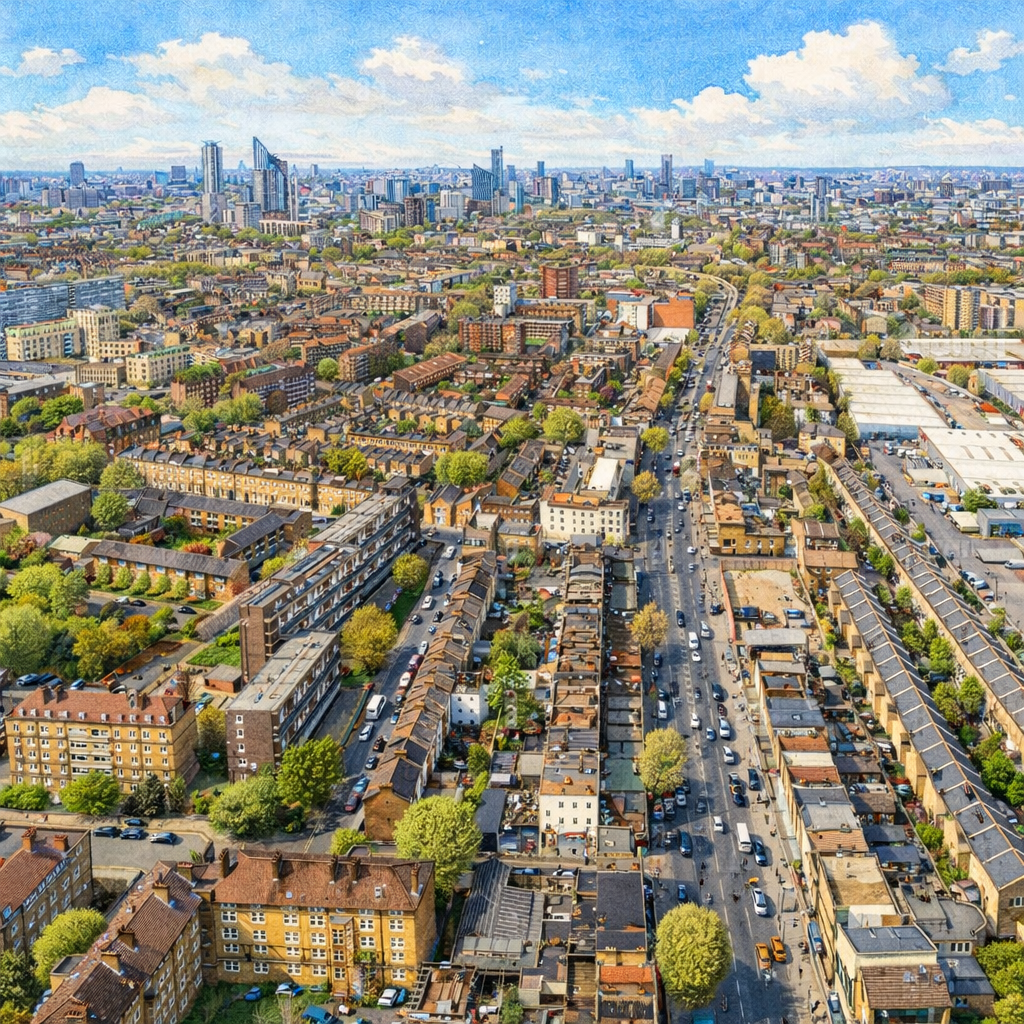
Southwark’s long planned remaking of Old Kent Road has now entered that stage at which a project ceases to appear as one proposal among many and begins instead to reveal the governing philosophy from which it springs. The official promise is by now familiar enough: 20,000 homes, 10,000 jobs, new parks, a remade high street, and, somewhere beyond the present horizon, the future arrival of the Bakerloo line. Yet the deeper reality is neither so innocent nor so local. What is being organised here is not merely redevelopment in the ordinary sense, nor even the intensification of an urban corridor under pressure, but one more chapter in the larger remaking of London as a rentier metropolis, a city increasingly governed as an asset, where land is converted into liquidity, planning is recoded as the management of yield, and communities are invited to bear upheaval in the name of benefits they may never truly possess.
There are times in the life of a city when the local language of planning becomes too small for the forces moving beneath it. The official vocabulary remains as it so often does: calm, procedural, managerial, clothed in the familiar moral garments of improvement. It speaks of place making, of public realm, of mixed use vitality, of healthier streets and greater connectivity, of homes, jobs and opportunity. It borrows its authority from an older civic tradition, from the belief that to plan is to align growth with social purpose and to mediate, however imperfectly, between private ambition and public good. But the scale of a project has a way of revealing what its language is trying not to say. Old Kent Road is not being modestly renewed. It is being rewritten. And it is being rewritten at a scale sufficient to expose the wider order in which it has been enrolled.
Southwark’s draft Old Kent Road Area Action Plan announces this with the impersonal confidence of administration. Over the next twenty years the corridor is to be transformed by a sequence of strategic interventions intended to deliver around 20,000 homes, 10,000 jobs, new public spaces, new infrastructure, and a reconfigured urban form, all tied to the promise of future transport capacity and the rhetoric of metropolitan growth. The official record presents the matter in the syntax of plans and targets, of evidence bases and consultation documents, of diagrams that render a lived environment legible to institutional power. Yet the social meaning of the thing lies elsewhere. For the question before us is not finally how many units may be built, how high buildings may rise, or how many hectares may be turned from one use to another. It is, rather, a question of what kind of city London is becoming, and of the role Old Kent Road has been assigned within that becoming.
What is being advanced here is not simply a housing strategy or a transport led exercise in urban improvement, but one local expression of a wider condition that ConserveConnect’s recent essays have named with considerable force: the financialisation of the city itself. London, on this reading, is no longer treated chiefly as a habitat of social life, as the setting in which people dwell, work, trade, remember and reproduce themselves through time. It is treated increasingly as a managed field of assets, obligations and future revenue streams, a metropolis in which land becomes the substrate of leverage and neighbourhoods are drawn into the circuits of asset-manager capitalism. In that transformation, the city does not merely host finance. It is reconstituted in finance’s image.
Old Kent Road’s designation as an Opportunity Area belongs squarely within this order. The phrase carries an air of technical neutrality, but it conceals an entire political economy. Such an area is not merely a place where change may happen. It is a place where land may be assembled, revalued, leveraged and moved through the planning system with greater certainty, where the frictions of ordinary civic life, the stubbornness of existing use, and the moral claims of low value but socially necessary activity are gradually subordinated to a larger logic of throughput. Planning, under such conditions, does not merely regulate development. It prepares, secures and legitimises it in advance. The workshop, the small trader, the low rise plot, the modest industrial remnant, the older commercial terrace, the loose grain of ordinary urban life, all cease to appear as settled and meaningful elements of a living district. They are redescribed as underperforming, transitional, obsolete, underused, awaiting uplift. The act of naming is already half the work of displacement.
It is here that the language of brownfield renewal must be understood for what it so often is: not merely an ecological or spatial description, but a preliminary rhetoric of liquidation. Once a place has been sufficiently redescribed as waste, inefficiency, redundancy or latent capacity, the moral weight of what already exists begins to thin. The social labour embedded in the district, the habits of use that gave it continuity, the quiet forms of dependence through which low margin lives sustain themselves, all are made to appear incidental beside the shining claims of optimisation. In this way, renewal ceases to mean repair, stewardship or civic care, and comes instead to mean the preparation of space for conversion into yield. The issue before us, then, is not only redevelopment. It is rentier redevelopment: a mode of urban change in which value is drawn less from what a place produces socially, culturally or civically than from what may be extracted from it through uplift, scarcity, tenure engineering, viability concessions and the managed circulation of land through increasingly financialised channels.
This deeper structure becomes especially clear when one turns to the corridor’s transport logic, for Old Kent Road’s present contradiction is transport. The future Bakerloo line extension has long been invoked as the enabling promise, the infrastructural blessing that will redeem the scale of transformation now being advanced. But promises have their own politics, and one of the central arts of the asset city is the projection of a future as if it were already sufficiently real to justify present intervention. TfL continues to describe the extension via Old Kent Road and New Cross Gate as the preferred route, yet the project remains in development and subject to future funding and approvals. The line remains under consideration; the route continues to be presented as preferred; yet the scheme is still contingent, still dependent on funding, still lodged in that uncertain territory where ambition exceeds guarantee. This is no minor administrative footnote. It means that the area is being asked to internalise the costs of a future that has not yet materialised, to endure its upheavals now because one day the material conditions that supposedly justify them may arrive. One part of the future is spoken in the tense of inevitability, while the other remains suspended in the tense of institutional delay. Such asymmetry is not incidental. It is characteristic of financialised planning itself, in which future value is stabilised rhetorically in order that present land may be reorganised materially.
This is one reason, though not the only one, why objections have multiplied. Yet to describe these objections as though they were merely an accumulation of local complaints is to miss their deeper significance. For the most intelligent among them are not simply reactions to height, density, congestion or inconvenience, though they naturally assume those forms in the language available to residents confronting the machinery of planning. They are recognitions, however partial or instinctive, of a broader political economy pressing itself into local ground. People speak of overdevelopment, of student heavy provision, of weak affordable housing, of pressure on infrastructure, of the erosion of traders, workshops and everyday spaces. They speak, that is, in the ordinary idiom of place under threat. But beneath those immediate concerns lies a more serious diagnosis: that Old Kent Road is being asked to perform as a balance sheet before it is allowed to remain a neighbourhood.
The housing question makes the matter plain. A recent scheme near the corridor proposed 465 student flats alongside only 26 social rented homes. One need not indulge in easy anti-development sentiment, nor pretend that cities can stand still, to understand what such a ratio reveals. It reveals a city in which production is increasingly aligned to investment demand rather than social need, a city in which the dwelling is conceived less as a form of settlement than as a revenue bearing unit within a wider circuit of accumulation. Student accommodation, institutional rental products, mixed use formulas tailored to investor confidence, these are not simply neutral responses to demographic necessity. They are tenure forms that fit the imperatives of a rentier order: predictable income, controlled occupancy, stable cash flow, manageable yield. The difficulty, then, is not only that affordable housing is too scarce, though it plainly is. The deeper difficulty is that the whole structure of provision is being shaped by a logic in which housing exists increasingly for circulation rather than habitation. As ConserveConnect’s broader London Plan analysis argues, the crisis is not reducible to quantity alone. It is a crisis of allocation, ownership and control, a condition in which dwellings may be produced in considerable number while access to them remains rationed by price, tenure and financial design.
The same clarity is required when one speaks of displacement, for here too the official language has long performed an act of concealment. Displacement is usually described as an unfortunate side effect, regrettable but manageable, an incidental by-product of otherwise necessary growth. Yet in the urban order now consolidating itself across London, displacement is much closer to a structural condition than to an accident. Lower value uses do not simply happen to suffer from redevelopment. They are precisely the uses that become vulnerable once land is reorganised to serve a more intensive and more lucrative regime of circulation. Workshops, independent traders, modest industrial remnants, repair economies, social clubs, cheap premises, informal forms of urban interdependence, these are not empty spaces awaiting improvement. They are spaces of use whose very modesty makes them incompatible with the expectations of uplift. To clear them is not always to demolish them physically at once. It is often enough to reprice them, to thin them, to place them under conditions they can no longer survive. In this sense, displacement is not an unfortunate residue of financialised redevelopment. It is one of its methods.
And so the corridor’s predicament becomes legible in wider metropolitan terms. Across London the pattern repeats with wearying consistency: land is converted to liquidity, liquidity is converted to debt, debt is converted to towers, enclaves or managed districts, and the social density that once made a place meaningful is gradually transformed into absence. The process may be justified by many languages, by housing need, brownfield renewal, sustainable density, transport led growth, but its operative morality remains that of the balance sheet. A place is measured increasingly by what can be extracted from it, not by what it already sustains.
At this point the question of continuity becomes unavoidable, for continuity is the point at which redevelopment most often reveals what it cannot understand. The Brick Lane essay is powerful because it refuses the false separation between built fabric and social life. When communities are displaced, architecture becomes hollow décor; when buildings are erased, memory loses its anchor. That insight applies with equal force here, though Old Kent Road’s significance has not always been narrated in the picturesque and easily marketable language reserved for more obviously celebrated districts. The corridor is not an empty strip between more important places, nor a blank field awaiting metropolitan purpose. It is a layered environment of traders, workshops, social infrastructures, older plots, industrial traces, and ordinary forms of economic and social life that do not announce themselves as heritage because they have not yet been fully stripped of use. To redescribe such a place as capacity is already to begin the work of erasure. It turns what is inhabited into what is available, and what is available into what may be traded.
A city, however, is not merely a container for investment. It is an historical arrangement of memory, labour and mutual dependence. Its moral life is carried not only by monuments and protected views but by the fine grain of ordinary use, by the modest continuities through which people recognise themselves in the places they inhabit. Once that fine grain is sacrificed to a larger and more abstract order, the city may continue to function administratively, economically, visually even, but something essential in it begins to drain away. The street remains, but its social substance thins. The building survives, but as stage set. The heritage is retained, but only cosmetically, its living context gone. And because such loss is often gradual, because it appears first as revaluation rather than as ruination, a city can lose itself long before it notices the loss.
All of this returns us to the word viability, one of the most revealing terms in the contemporary planning lexicon because of the quiet moral reversal it performs. Viability once functioned, at least in theory, as a technical safeguard, a way of ensuring that policy requirements did not render development impossible. But under financialised urbanism it has become far more than that. It has become a governing principle through which public purpose itself must prove compatible with private profitability. The burden of justification, once placed upon those who sought to profit from land, has shifted back onto the public interest. Heritage must justify its cost. Affordable housing must justify its quantity. Public realm, social infrastructure, design quality, environmental standards, all must present themselves at the tribunal of yield and ask permission to survive. Profitability, by contrast, arrives with the presumption of legitimacy already attached. This is not only a technical transformation. It is a transformation in political morality. Public interest becomes conditional. Profit does not.
That is why Old Kent Road matters beyond itself. It is not merely one more pressure point in a growing city, nor simply another corridor where cranes, consultations and strategic sites gather around a language of improvement. It is one of the places where London’s deeper mutation into what your essays call the asset state becomes visible in concrete form. There, planning becomes pipeline management, land becomes collateral, housing becomes a revenue stream, and citizenship itself risks becoming secondary to investment. The language of regeneration still invokes public benefit, and perhaps certain public benefits will indeed be produced. But that is not the decisive question. The decisive question is by what mechanism those benefits are secured, at whose expense they are purchased, and what form of urban life is normalised in the process.
Those who wish to understand the matter should still begin with the official record, for one must know the declared case before one can criticise it properly. The formal planning documents, the examination materials, the local register of applications and objections, these remain indispensable not because they tell the whole truth, but because they reveal the official form in which partial truths are organised. Southwark’s Examination in Public page is the central entry point for the plan and its evidence base, while the council’s planning register is where live applications can be searched and commented on. Yet objections of any depth will have to do more than list harms. They will need to connect the local to the structural, to say not only that a scheme is too tall, too dense, too weak on affordable housing, too destructive of amenity or local character, though it may be all those things, but that a deeper model is at work, one in which the city is increasingly governed for circulation rather than habitation, and in which Old Kent Road is being asked to submit itself to that order.
For Old Kent Road is not only a development corridor. It is a civic argument in physical form. The official city sees capacity, throughput, optimisation and uplift. The objecting city sees memory, use, attachment, obligation and social continuity. Between these two visions lies the real politics of planning, which is never finally about whether change will occur, because change always occurs, but about what kind of change is legitimised, in whose interests it is organised, and by what moral vocabulary it is made to appear inevitable.
If London is increasingly being remade as a city designed for circulation rather than habitation, then Old Kent Road is one of the places where that transition can be watched in real time. And if the objections now gathering can acquire not only passion but clarity, not only resentment but analysis, then it may also become one of the places where that transition is named for what it is and, in being named, more seriously contested.