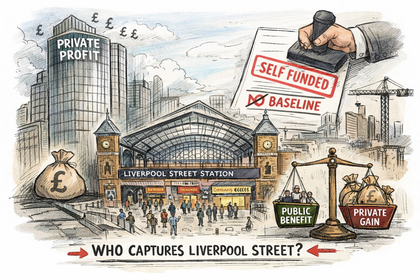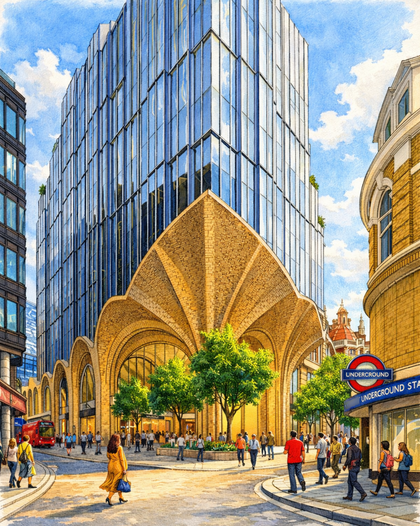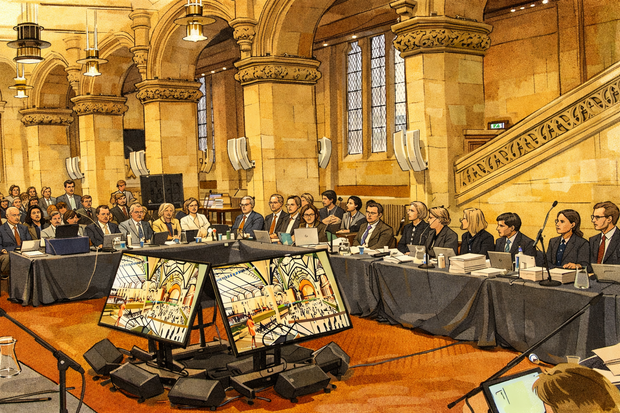
Liverpool Street Station’s redevelopment was approved yesterday by the City of London’s Planning Applications Sub-Committee by 19 votes to 3—a decision presented as a necessary transport upgrade, yet structured around an office-led over-station development that will permanently re-shape a listed Victorian landmark. The vote itself was decisive; the process that led to it was tightly managed, with objectors confined to a single shared ten-minute slot while the applicant side was able to expand and reframe its case through extended presentation and questioning. What is being normalised here is not simply a design outcome, but a governing model—public infrastructure financed through commercial mass, and “public benefit” asserted in ways that were not always made clear, stable, or easily intelligible on the day.
To understand the decision you have to hold two things together: the formal theatre of planning—procedure, speaking time, the language of balance—and the political economy beneath it—public assets, scarcity of public capital, and the routine deployment of “viability” as a governing doctrine. The station may be improved, we are told; but the improvement is yoked to an office superstructure of a scale that re-makes the listed Victorian station and its context. The public is asked to accept the bargain. The question is whether the bargain was ever made fully intelligible.
Ten minutes for the public, the rest for the apparatus
The Chair set the structure of proceedings in plain terms: officers first, then objectors “will have 10 minutes”, then questions; then applicants/supporters for 10 minutes, then ward members, then debate and vote. Immediately before objectors began, the Chair tightened the constraint: ten minutes total, no speaker more than five, with the reminder that objectors had “very unusually” been given 45 minutes the previous week.
It sounds administratively neat. Yet it creates a substantive distortion. Planning at this scale does not turn on slogans; it turns on claims about necessity—necessity of massing, necessity of demolition, necessity of the financing structure. You cannot compress heritage harm, construction disruption, alternative schemes, and financial architecture into a few minutes without turning public participation into a ritual rather than an inquiry. Time is not neutral. Time is power.
This is why the request made in the hearing to treat written representations as the “primary democratic evidence” was not rhetorical performance but procedural realism. Where the room limits speech, the written record becomes the only place the public can be fully heard—if members are willing to treat it as more than background noise.
The funding narrative that becomes destiny
In the modern planning system, certain phrases do not merely describe reality—they manufacture it. One of those phrases is the claim that the scale of over-station offices is directly linked to funding station works, and that the quantum is the minimum necessary on viability grounds. This is the frame that turns a contested development model into an inevitability.
A committee member pressed Network Rail on whether the massing above the station is effectively the only way to afford the substantial investment in the interchange. Network Rail’s response was blunt: funding is limited and this is the best solution they can identify to fund the project. Once that sentence lands, the committee is no longer weighing alternatives; it is being invited to ratify a constraint.
This is the false bind: accept demolition-led heritage harm, or lose station improvements. The point made by objectors was straightforward—members are not required to treat a financing doctrine as a planning inevitability, especially where a credible, independently testable “station-first baseline” separating essential station scope, cost, phasing, and heritage impact from the commercial package is absent. Without that baseline, benefits cannot be weighed against harm in a way the public can test, and alternatives cannot be compared on equal footing.
“Public benefits” asserted—then counted three different ways
The committee was repeatedly asked to accept that the scheme delivers significant passenger benefits, particularly through a larger lower concourse. Yet when members sought a straightforward, “definitive” statement of what was increasing and by how much, the figures did not hold steady.
Officers referred to a 19% increase in lower concourse space, while Network Rail cited 25%. A member then highlighted the discrepancy—recalling that other figures had also circulated—and asked for clarity. The response introduced multiple “tier” counting methods and then revised the headline number again, giving an existing basement concourse of 31,000 sq ft and a proposed 38,000 sq ft, described as an increase of 23% (“when we said 25, we went 23”).
This may reflect different measurement conventions, but that is precisely the point: a committee cannot weigh public benefit against heritage harm if the public benefit is presented through shifting baselines and moving percentages. Where the benefit case is central to the justification, it must be stated in stable, plain terms—what space, what definition, what increase—so that members and the public can understand the trade being made.
A basic problem of public comprehension
There was, too, a simpler issue: intelligibility. One of the principal applicant-side speakers was ACME’s architect, Friedrich Ludwig. His contribution is broadly understandable if one listens carefully, but the transcript records repeated mis-hearings and garbled phrases—signs that, in a live committee setting, the combination of pace, acoustics and accent made parts of the presentation harder to follow than they should have been.
That matters not as a personal criticism, but as a procedural point. In a hearing of exceptional public interest, clarity is part of fairness. Where key justifications are being advanced in real time, the authority has a responsibility to ensure principal presentations are audible, comprehensible, and accurately captured in the public record—through reliable audio, disciplined pacing, and clear supporting materials.
The Architecture of the Hearing
Before turning to the larger argument about public assets, it is worth examining the structure of the hearing itself. Planning decisions are not shaped only by what is said, but by who is given time to say it—and for how long. The transcript timestamps show how the 2 hour 22 minute public session was distributed between objectors, officers, applicants, ward members and committee debate.
What follows is not interpretation. It is a straightforward account of time allocation drawn from the official record.
Hearing Time Allocation: Who Spoke, and for How Long
Total public session: 2h 22m 34s.
Objectors (opposed parties)
- Objector statements: 11m 07s (01:02:14 → 01:13:21)
- Committee questions to objectors (objectors responding): 4m 04s (01:13:21 → 01:17:25)
Total objector airtime: 15m 11s
Supporters and enabling parties
- Officer presentation recommending approval: ~46m 21s (00:14:48 → 01:01:09)
- Applicant/supporter statements (Network Rail + applicant team incl. ACME): 10m 31s (01:17:25 → 01:27:56)
- Committee questions to applicants/supporters: 23m 27s (01:27:56 → 01:51:23)
- Bishopsgate ward members (supporting slot): 8m 29s (01:51:23 → 01:59:52)
- Further committee questions to officers: 7m 42s (01:59:52 → 02:07:34)
- Committee debate + vote: 15m 00s (02:07:34 → 02:22:34)
Objectors accounted for approximately 11% of total hearing time. The remainder was taken by the officer case for approval, applicant/supporter presentations, supportive ward statements, committee-led questioning and debate.
Procedural note: questioning is committee-led; objectors are questioned by members but are not given an equivalent opportunity to question the committee or applicant team in return.
The Conditions Under Which the Decision Was Taken
Time allocation was only one dimension of the imbalance.
Key addendum papers were circulated on the day of determination, with further material tabled at the meeting and a short pause for members to read it before proceedings resumed. For a scheme of this scale—turning on contested questions of public benefit, heritage harm and viability—same-day addenda compress the window for meaningful scrutiny and rebuttal.
Objectors were also required to self-organise into a single shared slot at short notice. Distinct objections were compressed into a composite intervention, while the applicant side appeared as a coordinated panel.
Before the vote, the Chair and Vice-Chair addressed the committee, shaping the tone and framing of deliberation. That is within their remit. Yet remarks immediately preceding determination operate as institutional signals. Chairing power is subtle—it governs sequencing, emphasis, and the atmosphere in which members make their final decision.
A deeper question: what is the best use of public property?
Liverpool Street Station is not private land waiting for its highest bidder. It is a public transport asset managed by Network Rail. That matters because the airspace above the station—now the site of office-led intensification—is itself a public asset in economic form. When public infrastructure is upgraded through the creation and capture of commercial rent, we are no longer in the realm of “development” alone; we are in the realm of asset strategy.
Here “viability” does ideological work. It reduces democratic choice to a ledger constraint: we cannot fund the station unless we build the office quantum. Yet viability is not a natural law. It is a model shaped by assumptions and contract structures the public rarely sees. If the “station-first baseline” is absent, then the public cannot judge whether the commercial massing is genuinely the minimum necessary—or simply the maximum bankable within current property-finance expectations.
This is why the public is entitled to ask a question that planning committees too often treat as impolite: is this the best use of public property managed by Network Rail? And if it is, where is the transparent accounting that shows it—baseline costed station works, delivery safeguards, and the financial terms by which airspace value is being converted into private development mass?
The city is not being asked merely to approve a building. It is being asked to approve a financial architecture whose details are treated as background, and whose consequences are permanent. In such conditions, the language of “necessity” expands, while the space for democratic alternatives contracts.
The vote: 19–3, and what it signals
A 19–3 approval is not a marginal technical judgment; it is a decisive endorsement of a governing model: heritage harm justified by public benefits framed through contested numbers, and financed through office-led intensification presented as necessity.
The danger is precedent. Once this bargain is accepted at Liverpool Street, it becomes easier to repeat it elsewhere: public infrastructure made to “pay for itself” by being reconfigured as a development platform; public debate narrowed to procedure; and the public told that there is no alternative—because the alternative has not been properly placed on the table.
What comes next: scrutiny, not resignation
Approval is not the end of politics; it is the beginning of implementation. The next struggle will move to conditions, phasing, disruption, and the practical meaning of “public benefit” in lived experience. It will also move to the question that sits behind every viability-led megaproject: what was promised, what was delivered, and what was quietly traded away.
ConserveConnect.News will publish a follow-up analysis of the hearing record focusing on: the democratic structure of the hearing; the funding narrative that was treated as destiny; and the missing station-first baseline without which the public cannot judge necessity, value, or alternatives.
Because when a city tells you there is no alternative, the first civic duty is to ask who benefits from that claim—and who had the time to make it sound inevitable.
In the end, the issue is not whether Liverpool Street Station requires improvement. It does. The issue is whether a decision of this magnitude—permanent alteration of a listed landmark and the commercialisation of public airspace—was examined under conditions that allowed genuine scrutiny. When objectors are confined to fifteen minutes in a two-hour session; when benefit figures shift under questioning; when addendum material appears on the day of determination; and when financing doctrine is presented as destiny rather than as a choice, the appearance of balance masks a deeper asymmetry. A 19–3 vote settles the formal question. It does not settle the question of whether the process met the standard of democratic clarity that public assets deserve.
Editorial Note
This report is a fair and accurate account of open proceedings at the City of London Planning Applications Sub-Committee meeting held on 10 February 2026, based on the publicly available webcast and transcript record.
It is published in good faith and is protected by qualified privilege under Schedule 1 of the Defamation Act 1996 insofar as it reports proceedings of a public authority.
Commentary and interpretation reflect the author’s independent analysis of matters of public interest, prepared in accordance with the National Union of Journalists’ Code of Conduct and IPSO Editors’ Code principles of accuracy, fairness, and responsible journalism.