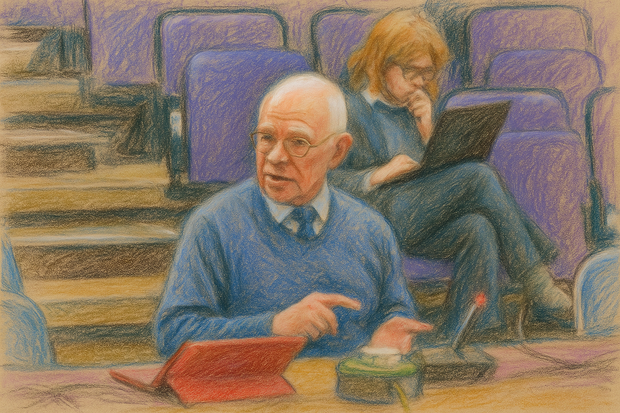
With the appeal now recovered by the Secretary of State, the morning of Day 8 marked a pivotal shift in tone. Evidence moved from architectural impacts to systemic inequality, as Rule 6 witnesses presented arguments about displacement, procedural bias, and the limits of public consultation. If earlier sessions debated form and façade, this one interrogated the very legitimacy of planning and its underlying audience.
Procedural Opening: A Different Audience
The morning began with administrative discussion between the Inspector, Russell Harris KC (for the appellant), Richard Wald KC (for the Council), and Flora Curtis (for the Rule 6 Party).
Russell Harris noted that the case, now recovered by the Secretary of State, had “a different audience.” The Inspector would make recommendations, but the final decision would rest with central government. Harris proposed to submit a bundle of national data-centre decisions — including those on Drop Farm and The Hayes — to establish precedent consistency. The Inspector agreed.
In this reframed context, the hearing resumed with new witnesses for the Rule 6 Party.
Adam Almeida (Urban Economist, Rule 6 Witness)
Curtis introduced Adam Almeida, a data analyst specialising in urban inequality and community displacement, with affiliations to Common Wealth, Runnymede Trust, and the Centre for Labour and Social Studies (CLASS). His evidence was framed as a counter-model to the appellants’ commercial claims — a “data-informed reality check” rooted in Tower Hamlets’ economic geography.
Almeida presented quantitative findings on economic precarity, arguing that the area’s Bangladeshi population — the largest in the UK — faced “structural marginalisation despite proximity to wealth.” The redevelopment would exacerbate gentrification, he said, replicating patterns at Elephant & Castle, Ward’s Corner, and Hackney Wick.
“This is consistent across my work,” he said. “It’s not regeneration that’s opposed — it’s regeneration that cascades costs outward and fails to deliver meaningful affordability.”
He challenged the claim that “no displacement” would occur outside the site boundary, calling it “implausible.” He cited comparative rental data and business turnover statistics, noting that indirect displacement typically begins before planning approval — through speculative buyouts, anticipation rents, and commercial sector reshuffling.
Almeida also challenged the economic rationale underpinning the scheme:
- The 10% “affordable” workspace was “paltry.”
- The six affordable housing units were “not meaningful in any way.”
- Forecasted office-worker spending (£8.71/day) would not benefit Bangladeshi-owned businesses due to sectoral mismatch and changing consumption patterns.
- “The death of lunchtime,” he said, reflected a shift in worker behaviour — people no longer eat on Brick Lane.
He concluded with a warning: regeneration is not a neutral economic event but a redistribution of vulnerability.
Under cross-examination by Andrew Parkinson KC, Almeida acknowledged that some of his data preceded the current proposal but insisted that the economic logics remained unchanged.
Cllr Peter Golds (Tower Hamlets Council)
Next came Cllr Peter Golds, a senior Conservative councillor and longtime chair of Tower Hamlets’ Licensing Committee. He spoke as both a civic representative and local historian, describing Brick Lane’s evolution as one shaped by community resilience amid structural neglect.
His testimony had two major strands:
i) Licensing and the Community Impact Zone (CIZ)
Golds explained that Brick Lane had been designated a CIZ to control saturation and antisocial behaviour. The aim was not restriction, but balance — allowing daytime vitality while protecting residential calm at night. He cited Met Police data showing the Shoreditch Triangle (including the Truman site) now exceeds Piccadilly Circus and Leicester Square for weekend disturbances.
ii) Democracy and the Neighbourhood Plan
Golds then raised serious procedural concerns over the 2019 Neighbourhood Plan referendum, alleging widespread irregularities. Almost half of the business votes came from the Truman Brewery address. Jason Zeloof, Oren Zeloof, their Jersey-based company, and other associates allegedly cast multiple votes, some illegally, in breach of guidance rules.
“Mr Zeloof voted five times,” Golds said. “Another voted four times. We reported it to the police — but the Met don’t like getting involved in electoral malpractice.”
The Inspector urged caution, noting the public nature of the forum, but allowed Golds to finish. His point, he said, was about trust: “This development will shape Brick Lane for the rest of the century. We must get it right.”
Seema Manchanda (Planning Consultant, Rule 6 Witness)
Planning expert Seema Manchanda followed with detailed critiques on planning balance, equality impact, and site logic.
A former Head of Planning at Wandsworth and a national race-equality campaigner, she argued that the scheme failed both policy standards and moral obligations:
- The scheme’s “less than substantial harm” (per the NPPF) must be judged in tandem with community identity — “not in abstraction.”
- On balance: the harms outweigh the benefits, especially given the failure to meet housing need and the limited community gain.
- The Equality Impact Assessment (EqIA) failed to account for the intersectionality of poverty and ethnicity in Tower Hamlets.
Citing the Runnymede Trust and the Index of Multiple Deprivation, Manchanda called for a deeper model of equality — not just compliance, but participation.
In cross-examination, Parkinson asked whether the Secretary of State, having access to all Inquiry evidence, could still comply with the equality duty.
“My charity finds the Public Sector Equality Duty a weak piece of legislation,” Manchanda replied, “but I hope you do your best with it.”
The Inspector dryly added:
“One generally does do one’s best with legislation you sometimes scratch your head about.”
Curtis re-examined, highlighting that the Equality Impact Assessment omitted key concerns raised in public consultation — displacement, cultural erosion, and lack of engagement.
Critical Reflections: Planning as Contest Over Legitimacy
By the session’s end, a broader theme emerged: the transformation of planning into a site of political contestation.
- Almeida’s data showed how financialised development displaces long-standing communities while promising inclusive growth.
- Golds’ testimony pointed to structural bias — procedural and political — in how “local support” is manufactured.
- Manchanda’s intervention exposed the limits of formal equality mechanisms, especially in contexts of deep, racialised deprivation.
Where once regeneration debates centred on material form, Day 8 turned them inside out: revealing that what’s contested is not just the architecture of the scheme, but the architecture of decision-making itself.
Summary and Outlook
With the Secretary of State now in charge, proceedings have taken on a heightened political charge. What’s at stake is no longer just the fate of a former brewery — but the legitimacy of public planning in a city increasingly governed by private logic.
Next steps:
- Remaining cross-examinations of appellant witnesses (notably Mr Marginson).
- Planning obligations and conditions.
- Final closing submissions next week.
Editorial Note
This report is a fair and accurate account of open proceedings at the Truman Brewery Public Inquiry, verified against the official transcript and recording. Commentary and interpretation reflect the author’s independent analysis, in accordance with NUJ and IPSO standards. The reporting is protected under qualified privilege as set out in Schedule 1 of the Defamation Act 1996.